Pages

Sunday, 25 August 2013

Welcome September 2013!


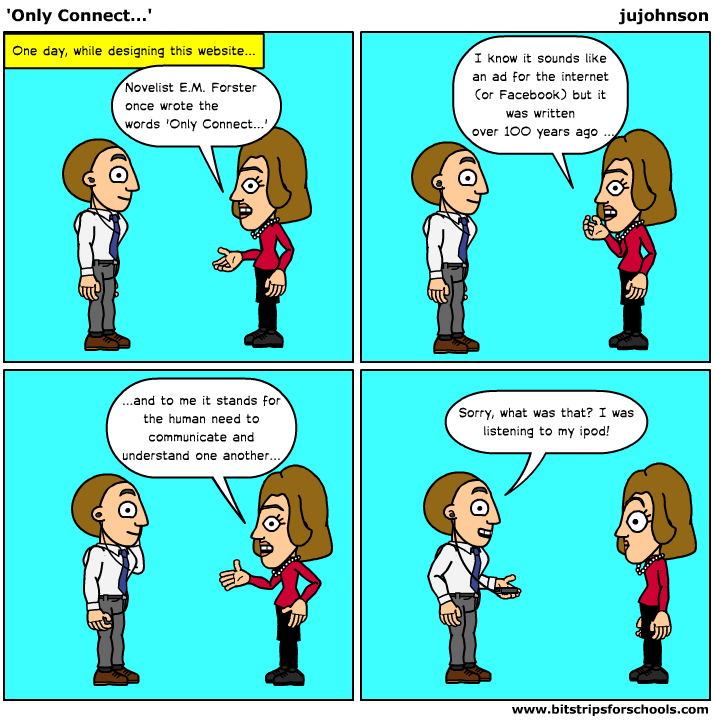
Only Connect... by JJohnsonn on GoAnimate

"ONLY CONNECT"... These two simple words, (the epigraph to E.M. Foresters 1910 novel "Howard's End") have stuck with me since I was an undergrad at University studying English in the 1990's.

They sum up the essence of literacy &, I believe, the purpose of school. We are communicators. We read, we write, we solve, we learn, we share through a wide variety of mediums. The technology age has only enhanced this aspect of our human nature. We tweet. We blog. We facebook.  We continue to read, write, learn and share in new ways and as such are becoming digital citizens.

I post blogs on a regular basis so be sure to check in often. The purpose of this site is:
  • to provide digital connection between myself, students,  parents, the community & other educators or interested parties. It acts as an online newsletter for everyone to know what AWESOME learning activities are going on in this classroom!
  • to act as a teaching tool in this class as I post & connect learning items. I often post material on this site that I use in the classroom. 
  • to organize material. I either post links to downloadable documents related to assignments on this blog that can be downloaded from home OR post success criteria and assignment information directly as a blog post.
  • to act as a showcase of student work
As you can see, there are several pages, blogs and links. This site will grow as this class grows through the year.

Please explore the site & let me know if you've any questions, concerns or comments! I always welcome feedback. My email is jujohnson@mail1.scdsb.on.ca.

Julie Johnson, teacher

PS I also created a comic based on the theme 'only connect'...

Friday, 31 May 2013

Health Unit: "Growth and Development"

On Monday, we start our last health unit on "Growth & Development" aka Sex Education.

There are the curriculum expectations for this unit:

OVERALL: describe age appropriate matters related to sexuality (eg. the need to develop good interpersonal skills, such as the ability to communicate effectively with the opposite sex).

SPECIFIC:
-explain male and female reproductive systems as they relate to fertilizations
-distinguish between the facts and myths associated with menstruation, spermatogenesis and fertilization
-identify the methods of transmission and the symptoms of sexually transmitted diseases (STDS) and ways to prevent them
-use effective communication skills (eg. refusal skills, active listening) to deal with various relationships and situations.
-explain the term 'abstinence' as it applies to healthy sexuality
-identify sources of support with regard to issues related to healthy sexuality (eg. parents/guardians, doctors)

For this unit, we will be watching Learn 360 videos based on the above curriculum goals:


  • "We're Growing Up" (puberty changes, body processes, hormones/reproductive systems)
  • "Am I Normal?" (discusses scenarios requiring decision making skills, STDs, pregnancy prevention)
  • "Teens and Sex: What you need to know" (discusses scenarios required decision making skills, STDs, pregnancy prevention, reproductive systems)
  • "Straight Talk About Sexual Choices and Consequences" (discusses scenarios required decision making skills, healthy relationships, peer pressure, hormones/emotions, STD, pregnancy, abstinence)

If you have any questions about this unit, please let me know.

Saturday, 18 May 2013

Poetry, Lyrics, and Music Videos as 'Visual Poems'

On Friday we kicked off our next literacy unit: Poetry, Lyrics and Media Study. This unit essential involves investigating song lyrics of modern times, poems from olden times (with comparisons between then and now) and modern day visual representations of both (on youtube and as music videos). It is one of my favourite units  and so much fun to teach.

We started with Stereo Hearts by Gym Class Heros. This was a perfect song to start with, especially given it was a Friday before a long weekend: peppy, happy, everyone sings along...and the lyrics have surprising depth. The song is essentially one giant example of figurative language..we studied 6 metaphors/similes specifically, explaining and interpreting them.

That lead us to 'main idea' suggestions: I put 5 on chart paper, that students suggested (most ideas had to do with: 'wanting to love' but also 'wanting to be loved', especially 'for who they are'--even though they are heavy and old like a boom box, and have scratches like an old record').

Then we looked at the music video. Students had to 'judge how effectively the visual representations portrayed the main idea of the text'. To do this, of course, they must interpret the images.

I encourage students to jot down every image they see in the music video...then choose the top 5, the five that seem most important.


We realized the video seems to involve a lot of shadow, it is quite grey in tone, and very 'real world'...the pavement is cracked, for example. Also, why is he so alone? Random people walk by...but where is the romantic interest? He is singing this song to someone, asking if he can love them and asking to be loved in spite of flaws. So...where is this person? Why isn't the video 'more romantic'?

At the end, students had to decide yes or no...was this an effective representation? Most students said no, primarily because  it seemed at odds with the idea of love and romance. But a surprising number said 'yes', it was an effective representation...because he is asking to be loved 'as is'...and reality involves shadows and cracked pavement. It's 'not fake'.

Very clever!

Of course, there is no right or wrong answer. It all depends how how well you can justify and explain your opinion, supporting your opinion with evidence from the text.

But it certainly draws forth some interesting conversations!

One reason why I enjoy this unit is because we take such 'mundane' elements of 'pop culture' and realize their intrinsic power. As I told the students, the lyrics they hear on their MP3 players etc are modern day poems. Every time they listen, they are connecting with and interpreting poetry. And the music videos are 'visual poems'.

The idea of 'poetry' often seems so old fashioned to students...when I say we are studying poetry, there are always a few groans. Its like they think that all the poets are from a hundred plus years ago and thus must not have relevancy. Oh, but they do! One particular aspect of this unit I enjoy is taking poems from yesteryear and comparing them to modern day lyrics, such as when I contrast Coolio's Gangster Paradise song (1995) with Percy Shelley's Ozymadias (1818)...and then we look at youtube interpretations of Shelley's poem, created by modern readers...

I truly can't wait to see what my class thinks of that!

PS. I enjoy this topic so much I created a website out of it...see lyrics.poplit.net

Friday, 10 May 2013

Guest Speaker: Writer Kevin McGill

Today writer Kevin McGill will be speaking to the class via Skype.

Kevin has been a guest speaker for me in previous years and he is always an enjoyable guest to have. He was also one of the presenters during my Junior/Intermediate Boy's Literacy Event a few years ago (which you can read about via news articles here. You will need to scroll down!)

Kevin's has written a young adult series called Nikolas & Co. He also sent his book into space! (For real!)

As an oral language task, students have paired up and determined an interview question for Kevin. Questions could be about writing, books or sending his book into space...but they all have to be unique! During the interview, one student asks the question during the interview, the other writes down the answer. Later, the student who wrote the answer will need to present their response as part of a class podcast, which I will eventually post here.

Thanks, Kevin, for taking the time to speak with us today!

ADDENDUM: As promised, here is the podcast!


Tuesday, 7 May 2013

Oral Language & Media: Travel Presentations

I like to build oral language skills gradually though out the year. Students have had ample practice by now in formally presenting material to peers as pairs and in small groups. Now students will be presenting to the entire class is this new project that incorporates research skills and what I call 'financial literacy' skills.


"HAVE YOU EVER WANTED TO GET AWAY FROM IT ALL? Now's your chance!"

Students, either in pairs or individually, are being asked to research a 3-4 day 'dream vacation' to any destination by plane from Toronto. (No all inclusive packages and no trips to space, please!)

They will present the details as a presentation, which must include two parts:

PART A: TRIP ITINERARY
Using the internet, they are to plan every detail of their trip including:

-What flight will you take to get there?
-Where will you stay?
-What will you do each day? What sites will you see? What places will you visit? Is there a particular restaurant you want to eat in? Etc. 

PART B: BUDGET LISTS
Students will need to make a list of the real world costs. These can easily be found on the internet. NO PRETEND COSTS!

Costs to consider:
-airfare for each
-hotel costs for each (everyone gets their own room)
-daily living costs, if possible (breakfast/lunch/dinner)
-costs for any outings (such as admissions to museums, movies, sporting events, tourist attractions, etc)
-travel within the city or day trips (train fare, bus fare, etc) if applicable
-any other costs! (souvenirs?)

These are to be added up to show a total cost. 

A few points:
-students are not to  give any personal information out for any reason (like name or email)
-flights must leave from and return to Toronto
-if a flight does not leave on a Friday then pick any 3 to 4 day span (or whatever time frame works)
-no ‘all inclusive’ packages!

-no space travel!

We are working on these in class every Day 2 and Day 4. A total of 8 in class sessions are being allotted for this project. Tentative due date is set for end of class on Thursday May 23rd.  Presentations aim to take place the following day. 

CRITERIA (Oral Language)
- demonstrate an understanding of appropriate speaking behaviour by using effective presentation techniques (eye contact, volume and tone, etc)
 -communicate orally in a clear, coherent manner,
-use appropriate words, phrases, and terminology related to their research
-both participants must speak equally during the presentation

-the presentation is max 5 minutes in length
-the presentation has a media component  (such as powerpoint, Prezi)

CRITERIA (Media)
-include a budget list documenting the costs of your pretend weekend/long weekend trip, with a TOTAL COST included
-include photos, videos or sound clips that represent your travel plans
-include an itinerary of events (what you plan to do on your trip)

-spell common words correctly

Narrative Writing

As a culminating task for our narrative unit, students are being asked to write their own short stories, demonstrating knowledge of the narrative writing form.


Here are some ideas I proposed to get them started:
-use one of the stories you started during our literacy centers.
-use the ‘narrative cue cards’ to determine your plot, characters, setting
-write ‘fan fiction’ (choose a famous story, text/movie/media: Harry Potter, One Direction, Twilight, Mario & Luigi, Minecraft world, Star Wars, etc and write a story based on those characters and in that setting).
-write within a genre: mystery, fantasy, spy, ghost story, etc.
-play with Point of View: write from an unusual perspective! An inanimate object, a tree or natural object, the viewpoint of a villain like Darth Vadar, a Creeper etc)
-come up with your own idea!

Students are again using the writing process to organize themselves: brainstorming, first draft, peer edit, final copy. They are being given 7-8 in class sessions to work on it. After that, they must complete on their own time by the due date. 

The final copy is DUE MONDAY MAY 13th.

CRITERIA

-include a SUPER first sentence to interest the reader
-include obvious setting and characters
-include a plot with a clear problem and solution
-use vivid description that engages the reader’s senses (sight, sounds, smell, etc)
-use interesting words (no boring words like 'good' or 'bad')
-use dialogue to add drama
-include an interesting title that makes the reader curious

-spell common words correctly

Friday, 12 April 2013

Inanimate Alice: Synthesizing a New Episode!

There is a truly intriguing on line narrative called Inanimate Alice. It combines text with media (sound effects, music, images, games). We have watched the first 4 episodes as part of our narrative unit in literacy, focusing on the higher order thinking skill of SYNTHESIS.

SYNTHESIS is the ability to create, invent, compose, predict, plan, construct, design, imagine, propose and devise.

As students watched each episode, they completed an accompanying task, such as 'make a deep connection to the episode and provide proof', or 'explain how the media used (such as music or images) impact the mood', or 'make predictions about what will happen next', etc.

Now that we have finished watching all 4 episodes, students are being asked to DESIGN a new episode (in other words, synthesize their learning by combing elements and creating something new). Students have been given a choice in the method of their design: they can draw it in comic format, create it as a comic in bitstripsforschools.com, write it as a narrative, write it as a script, or create it using a tech format (prezi, powerpoint).

The criteria for their differing approaches remain the same. They are being asked to:

-refernence and/or include plot elements from previous episodes in a sensible manner
-reference and/or include characters from previous episodes in a sensible manner
-create a new setting that makes sense within the Inanimate Alice storyline
-create a new problem for Alice to solve
-create a solution for the problem that makes sense
-include ideas for media-such as music, sound effects, games, images, etc. that enhances the text

I happened to mention our Inanimate Alice project via Twitter--and Inanimate Alice wrote me via Twitter, indicating that they would love to see our finished producs! So I will eventually post many of them on our class blog to show them off!

Student episodes are due APRIL 22nd (Monday).

Tuesday, 2 April 2013

Frames 4 Animation Software

We are starting to explore Frames 4 animation software which is available on the school laptops. We will be using this software to create short media narratives.

To jump start creativity, I thought I would showcase here a few animations created last year in my Gr 7/8 class using this software. These were not meant to be narratives (I no longer have copies of the finished narratives, unfortunately). With these slides, students were just 'giving the program a try'--in particular, I asked students to create a couple of slides, to prove they knew how to make a simple animation--some students really came up with awesome beginning clips. All of these could easily go on to be narratives.


Saturday, 16 March 2013

Integers

In Math, just before the break, we started studying integers (positive and negative numbers). We started with determining where integers are in real life (golf, below/above sea level, debit/credit with money, temperature, latitudes and longitude etc) then moved on to placing integers on a number line and deciding which was greater or less than. Our next focus is adding and subtracting integers. This can be quite tricky. I thought I would post some support material for students in the area of integers, such as:

1. This is an excellent video series that shows ADDING INTEGERS WITH COUNTERS AND NUMBER LINE and SUBTRACTING INTEGERS WITH COUNTERS AND A NUMBER LINE. We learned these methods in class.


 2. This is also an excellent youtube video that walks through the steps of both addition and subtraction of integers using real world contexts.


3. Also, just for fun...a muscial interpretation to help students remember the addition/subtraction process for integers. Once you know which operation you need to do (add or subtract) you then know which direction to move on the number line (add goes right or up, subtract goes left or down).


4. The Khan Academy site has numerous explanatory videos to help understanding in a wide variety of math topics. Here are two videos pertaining to integers.

Example: Adding integers with different signs: Adding integers with different signs


Why Subtracting a Negative Equivalent to Adding a Positive: Intuition as to why subtracting a negative number is equivalent to adding the absolute value of that number


5. mathclips.ca has an extensive online lesson about comparing, ordering integers, using integers to represent change and how integers are used in real life.  It includes a variety of interactive activities.

6. mathisfun.com has an excellent resource sheet which explains how to add and subtract positive and negative numbers. 


7. Lastly, we will be playing this game in class....it also makes for good addition practice at home. Here's the how to:

Tuesday, 26 February 2013

BEDMAS as real world teaching

Part of the Gr. 7 curriculum is to 'evaluate expressions that involve whole numbers and decimals, including expressions that contrain brackets, using order of operations"--which inevitably leads us to BEDMAS (Brackets, exponents, division OR multiplication and addition OR subtraction).

Students quite enjoy the puzzle nature of cracking a BEDMAS equation like the one demonstrated in this Khan academy video:

8 + (5 x 4) - (6 + 10 divided by 2) + 44

I've also had students create questions like this for their peers to solve...they enjoy the challenge of both designing and 'cracking the code'.

Inevitably, though, students ask me--as they SHOULD--how does this relate to real life? When am I ever going to use BEDMAS in real life?

"Well, I'm soooo glad you asked," says I. Usually, a student asks me about 'real life' right from the get go whenever we start a new math unit but I typically plan to demonstrate real life applications anyway, because they are so necessary to solidifying math understanding. No one likes learning things one believes have no use! Math is too easily done in the head, abstractly, without connection to anything, just floating in the ether of logic and rationality. I've a few students that like to live in this math bubble, they enjoy the logic for logics sake and the puzzle for the sake of puzzling. But for the vast majority, math, at least at this level, needs to be grounded in reality or students disconnect.

Anyway, I initially wasn't so sure how to make BEDMAS 'real'. When I learned it, way back when, it was simply a matter of tackling a sheet full of questions by applying BEDMAS...and that's it.

Luckily, I found a selection of word problems online here and also this question that I found in the textbook.

The Cross Country Team ran timed circuits. Here are their times: 15.8 min, 12.5 min, 18.0 min, 14.2 min, 13.9 min, 16.0 min, 16.2 min, 17.5 min, 16.3 min, 15.6 min. Find the mean (average) time.

We had done mean previously, so they understand the HOW  (add up a set of #'s and divide by the total  # in the set). They just had to make the connection between 'multi step problem' and BEDMAS as a way of representing the multi-step procedure in a single expression!

Students solved this, and other word problems...but they had to write up their solution using the BEDMAS expression format, in other words communicate the order of steps as a single expression, as it would apply to that particular real life problem.

It is pure enjoyment to a teacher's ears to hear the various 'a-ha's' that went off around the room today as students realized that the order of operations/BEDMAS procedure was actually just a way of representing multistep operations...rather than just being this obscure, occasionally entertaining math question.

They were familiar with mutli step word problems... What they usually did was figure out the first step...then figure out the second step seperately. Now they could use order of operations/BEDMAS to a) put those steps all in one line/equation and b) effeciently COMMUNICATE to others the way to solve the problem...what to do first and what to second, and so on, by applying the BEDMAS rules.

Ultimately BEDMAS/order of operations is a communications tool. Sure, you can solve the problem as a two step and organize your response that way...or you could use a BEDMAS expression--you'll end up with the answer either way. But the advantage of BEDMAS is that is an easy way to communicate the order of steps to others, in an efficient one line.

Something so mundane as 'order of operations' turned into a real a-ha moment for my students today as they not only made the connection between math and real life but also the variety of ways math can be communicated...and how to be most efficient in the use of 'math language'. BEDMAS is just such an efficient and streamlined--dare I say elegant?-- way to communicate. Math tends to favour elegant simplicity!

Monday, 25 February 2013

Wrapping up before the Break!

As we head towards March Break, we are finishing up our non-fiction unit.

For example, the persuasive reviews students have written on a game, movie or book now need to be transformed into a point form presentation using either Power Point or prezi. com. These will be presented next week!
Also, we are coming to the end of our non-ficiton read aloud "Running To Extremes" and there will be a culminating tasks for everyone once we have finished this biography.

Students are also working on a reflection piece regarding their work up to now and I am in the process of conferencing one on one with students to hear what goals they have set for themselves for the remainder of the school year.

In math, we should be finished order of operations (BEDMAS) and should get started on integers before the break--we will likely continue them after the break. Continue to check out the math page on this blog to see what we are doing daily in math class!

After the break, we will launch into a new area of literacy...creative writing and the study of fictional narratives.  This will include a new read aloud (a novel voted on by the class), guided reading involving fiction narratives (tied to CASI practice...our last one is in April!), an interactive 'digital novel' called Inanimate Alice, various media representations of fictional narrative for us to evaluate and interpret, a Skype interview with my author friend, Kevin McGill (author of Nikolas & Co) and, of course, the creation of a narrative piece (a fictional short story). More details to come after the break!

Wednesday, 6 February 2013

Critically Assessing Games, Films and Fiction Texts

As mentioned previously, students are going to be asked to write a book, movie or game review as a means of demonstrating an ability to write a persuasive piece.

In my last post, we developed criteria for judging the effectiveness of a video game (such as quality of graphics, music/sound, multiplayer, etc) and then applied that criteria to a game. Students were encouraged to be as specific as possible in their judgements...to provide specific detail from the game to support their positions. For example, if they found the sound effects too annoying, then they had to give an example to back that up: "the woop, woop, woop for every power up sounds squeaky and is too repetitive".

After that, we looked at a review written on that game and evaluated it according to this checklist. Students had to explain what was done effectively (or not) according to the criteria on this checklist. (The reviews were written by prior students or by me).

The ability to evaluate and judge is considered a higher order thinking skill. It is a skill I am really pushing students to utilize in this unit, as not only are they evaluating a game/movie and text but also the reviews written about each of those things.

After the video game, we went through the same process for films. We developed criteria and then applied that to 3 short films, using our graphic organizer.

The 3 short films we watched were:
Order Up
Oktapodi
Bottle

Students were asked to use specific evidence from these films to support their opinion on what they did or did not like about aspects of the character, setting and plot. For example, the ending to Bottle was quite disappointing to some. They DID NOT LIKE IT at all. One of our criteria for a good movie was that the plot had a good resolution. They felt it DID NOT have a good resolution and they cited the details to support their opinion...which I won't state here, because I don't want to give away the ending.

Alternatively, others liked the ending. They thought it was a good resolution because it twisted your expectations... I encourage everyone to watch it and make up their own mind!

Again, after going through the process of critically evaluation the films and determining our own opinions, we looked at a review written on a movie (Mission Impossible: Ghost Protocol) and evaluated it according to the checklist.

Finally, as our last step in preparing for our own reviews, we will be looking at a short fiction text "Know All" from Paul Jenning's UNCANNY collection.  Students will again develop criteria, this time on what makes a good fiction text, and then we will apply those to the text. We will also look at a review written about it.

After that, students are to start the process of creating their own review on a game, movie or fiction text of their own choice.

I look forward to reading student reviews!

Wednesday, 30 January 2013

Playing Wii For Persuasive Writing


Those of you who know me, or have read my bio page, understand my interest in games based learning. Earlier this year, we used the Wii in math as part of our data management unit.

Now we are using it in a literacy capacity.  Today, we played and critiqued the Wii game New Super Mario Brothers Wii.

Four at a time, students were invited to the front of the room to play the game. Each game session lasted about a minute or so. After each session, we filled out a section on our brainstorming sheet as we prepare for review writing.

We were looking at: explaining & summarizing the game play, determining the effectiveness of the controls, the sounds (music, effects, voice), the graphics, the multi-player function (and justifying those opinions) and 'other' (student choice). We also looked at personal connections to the game and then every one gave the game their individual, overall rating.

Before we played, we brainstormed what made a game 'good' or 'bad', coming up with criteria with which to judge the game. It is considered a higher order thinking skills to be able to evaluate and assess with a critical eye...and also to justify one's opinions with evidence. We applied those skills to the video game and will continue to use those higher order thinking skills as we apply our critical eye to a short film and also a text as we continue in this persuasive writing unit.

Students got quite impassioned in their opinions today. Some thought the game too childish (for which they had to JUSTIFY their positon--for example, the graphics are too much like a cartoon, the game play is too easy) while some thought the game one of the best, ever (for which they had to JUSTIFY their position--for example, the music is happy & well suited to the sense of the fun that the game provides).

One thing we have been emphasizing in our reading & writing program is the need for SPECIFIC DETAILS. Whether writing personal narratives or answering comprehension questions on the CASI, students have been encouraged to put in specific details and to justify  their responses with details from the text...or in this case, the video game.

The final assignment in this unit will be a persuasive essay in the form of a review of a game, movie or book of student choice.

For more details on this persuasive writing unit, see my previous post called "Persuasive Writing"