Pages

Sunday, 27 November 2016

Exploring 'Main Idea' in Art & Beyond

We have been looking at the concept of 'main idea' (aka THEME) primarily within the context of our narrative study. It is, for example, one of the questions on the reading comprehension assessment, the CASI.

But we have broadened our study of 'main idea' to include different narrative forms: yes, it is in written narratives. It is also in media narratives (like short films) and musicals (like the Little Mermaid production we went to see).

It is also in Art.

So far in visual arts, we have examined (most) of the elements of design: line, shape/form, texture, value/colour, and (soon) shape.

We have looked at how different aspects of these elements convey different feelings, moods and ideas.

We have also started to look at how those elements communicate in a 'silent language'. They are used by artists to communicate a 'main idea'/theme.

We have just started this examination! We are examining artistic works to see how those elements are used to convey an overall message. This will eventually result in an art analysis paragraph.

We are also, as artists ourselves, exploring how we can use elements to convey an overall message.

In our geography curriculum, both Gr. 7 and 8 look at the preservation of natural resources and the issue of sustainability.

To practice creating a 'main idea' via artistic elements, I asked students to write their main idea on a stickee...and then try to match that main idea visually, in a drawing. Here are some of what the students created. (Take particular note of their choice/use of the art elements (especially line, shape/form, colour) to communicate their idea!)


In another instance, I invited The Simcoe County Greenbelt Coalition in to give a talk about water and how human activities/choices impact this natural resource.


I then asked students to convey the main idea, or gist, of the presentation in a composed photograph, using found objects in the classroom/school. This was indeed a bit of a challenge!

Again, the results were very interesting! Make sure you read what they posted, as that is the message they were trying to convey visually.


You can see how creating art in this context pushes students to the highest levels of Bloom's Taxonomy.


We will continue to explore this interesting intersection of creativity, visual communication, and theme/message/main idea, across additional curriculum... all of which aids us in our ability to not just creators of messages but also critical and aware 'decoders' of messages.


Wednesday, 23 November 2016

Drawing at School and Home!


In class we have been using sketch books to practice drawing. Sometimes we work on 'observational drawing' skills (noticing and replicating) and other times students are just drawing creatively (sort of like Free Write, but instead Free Draw).

A great way to get ideas about what to creatively draw is to use a site like Art Prompts.

http://artprompts.org/

So students if you are at home and want to draw, there are two things you could do:

1. Find any object, put it in front of you, and use observational drawing to notice and replicate OR
2. Use the prompt site to let your imagination and drawing skills roam free!

As with any skill, the more you draw, the better you get at it! PRACTICE PRACTICE PRACTICE

Monday, 14 November 2016

Little Mermaid

Mrs Czarnota would like me to remind you to please return your forms and money for Little Mermaid! Due tomorrow!

Math Review: FRACTIONS BOOT CAMP! Exercising our equivalent fraction math muscles!

Currently, we are looking at fractions in the numeracy unit.

We are in the midst of a rather thorough review. Fraction Bootcamp! The Fraction Reunion Tour!

We are exercising those MATH MUSCLES!

Math is very much like a house of cards. You need to have solid foundations in order to move up.

One key concept is the basic definition of what a fractions is: equal parts of a whole.

The denominator tells you how many equal pieces the whole has been cut up into. The numerator tells you how many pieces out of that you have.

The other key concept is the idea of equivalent fractions. The same amount is there, it has just been cut up differently.

The concept of equivalent fractions  impacts everything such as

  • converting improper to mixed number and back again
  • finding the simplest/simplified form
  • decimals conversions
  • adding/subtracting fractions with uncommon denominators
  • ordering and sorting fractions
  • determining greater than/less than


And so on.

It is such a key concept that I am spending a considerable amount of time on it, building in complexity. Building those MATH MUSCLES.

For instance, what is an equivalent fractions for 34/58?

Please feel free to follow along in our math task slide show and to use the math blog for resources as needed.

Friday, 11 November 2016

A Letter of Thanks

Students, this was an email I received after our Remembrance Day ceremony. 

Grade 7/8 students;

I wanted to send you a short note to commend you on the excellent Remembrance Day service that you lead today.  It was quite evident that you put a lot of thought and preparation into today's ceremony. It was great that you took time to recognize the wide variety veterans which we have in Canada as well as both the physical and psychological injuries which members of the Canadian Armed Forces have suffered.

I'm behalf of all Canadian soldiers, sailors and airmen and women thank you!

Major Ryan

Monday, 7 November 2016

Remembrance Day Assembly: Additional Materials

MINISTRY OF VETERANS AFFAIRS
In planning the assembly, we used the website from the Ministry of Veterans Affairs.  http://www.veterans.gc.ca/eng/

This website has considerable resources and we highly recommend spending some time on it!

The Guide to Commemorative Services helped us understand the traditional format for an assembly. It included links to digital music.

Besides giving a ceremony, there are numerous Ways To Remember. These could be done as an individual or as a classroom.

Educators, there are so many excellent resources to be found on the Veterans Affairs site. You can find a list of ideas here.

You might also find the Remembrance Timeline and History pages useful.


VETERAN'S STORIES
In our assembly, we wanted to show the impact of war on those who survive. The Veterans Affairs site has a vast collection of interviews (the 'Heros Remember Archive') with those who have served. Titles such as Were You Scared? and Like Losing a Family Member, among others, help us to understand the impact of war on those veterans who live through it.


EVA OLSSON
We included Eva Olsson in our Remembrance Day Assembly because her experience during the war as a civilian touched us deeply.

Here is the link to our media piece on Eva Olsson.

And here is her website. http://www.evaolsson.ca/Splash.aspx


MUSIC VIDEOS
These are considered powerful music/media pieces to show and discuss.
Highway of Heros
Pittance of Time

From our Assembly: Our google doc with embedded links

Thursday, 3 November 2016

Remembrance Day Assembly!

Our class is hosting this year's Remembrance Day Assembly.

We were very fortunate to have Major Ryan from Base Borden come into our class and share key resources and ideas with us and speak to us about Remembrance Day.

If you'd like to know more about our assembly, please click HERE.


Monday, 31 October 2016

SUPPLIES NEEDED! COMING SOON! Fence art/math task!

Around the end of November-ish, students will be completing a fence recycled art project. 

We will be making fence murals outside using a huge swath of fence. (see examples of other fence art below to get the idea!).

This is a math/art project that has a planning/implementing/reflection phase. 

It uses old materials, woven in through the fence to create a design. So materials need to be around 20 cm long at least for it to stay tucked.

I could use some help with supplies!

If you've got any of the following lingering in basements etc, please bring it into me over the next 2-3 weeks!

PLASTIC
plastic bags of all kinds
plastic tarps and old raincoats we could cut up
old xmas ribbon

CLOTH
old clothes, fabric swaths, drapes, table cloths, towels, we could cut up
yarn and ribbon odds and ends.

Or anything cloth or plastic that you think might be easily woven into a fence!

Our fence art gallery would be up for about a week or so, then dismantled and tidied up.

I'm looking forward to seeing how this art/math project develops! Here are some examples from other schools.


Mrs. J

Friday, 28 October 2016

MANY THANKS! GREAT HALLOWEEN FUN FAIR!

Many thanks to my awesome students who planned, organized, implemented this Shanty Bay tradition.

You kept your cool in spite of a few logistical mis-steps :) and were so incredibly responsible, dedicated, mature, and considerate.

You really put your heart into it (along with A LOT of effort) and I know the school is appreciative!

Next week, we will tally up our money totals for our donation to the food bank!

Great job everyone!


Thursday, 27 October 2016

Writing & Change Agents assignments: DUE SOON!

Two assignments are coming due shortly...

1. A revision of the Life Event students (a creative autobiography) *Due Nov 4.*

We have studied the 'writing traits' by looking at various, numerous examples of effective ('good') writing.


We have looked in student samples, ministry exemplars, and also by examining the books we've chosen for personal reading...good writing is everywhere! (Let's see what they are doing right! Or what needs to be improved, as the case may be!)

Now students are being asked to turn that critical eye to their own writing and use that vision, along with my feedback, to improve. (I wrote specific feedback to each student in their google docs.)]

Here's the checklist we have created in the classroom.


This checklist of criteria is similar to the one we have posted in the classroom and students can a;lso use it as a guide.


 I look forward to seeing your improved pieces!


2. Change Agent research and plan. *Due NOV 3* and onward *students, please make sure you have signed up for a conference time using the link in the side bar!

Over the past two months, students have been working on a long term Change Agent project.

We started with exploration of various Change Agents and issues, and have now asked students to narrow in on a topic.

Students have been given a lot of class time to research and plan in relation to their chosen area and they will be conferencing with myself and Mrs. Czarnota starting Nov 3 to clarify the details.

Parents, we ask that you talk with your child about their Change Agent plans, partly so you can hear more about what they are doing, but also so they can practice explaining their research and ideas in anticipation of the conference.  A letter was sent home today in regards to this, and you can also find it online: HERE

Once their plan is completed, and confirmed and approved by us, students can work on making their plan a reality.

For more information about the specifics of the Change Agent project, please see the class blog page above on the Change Agent project.

Monday, 24 October 2016

STEAM Challenge: Slow Marble Role

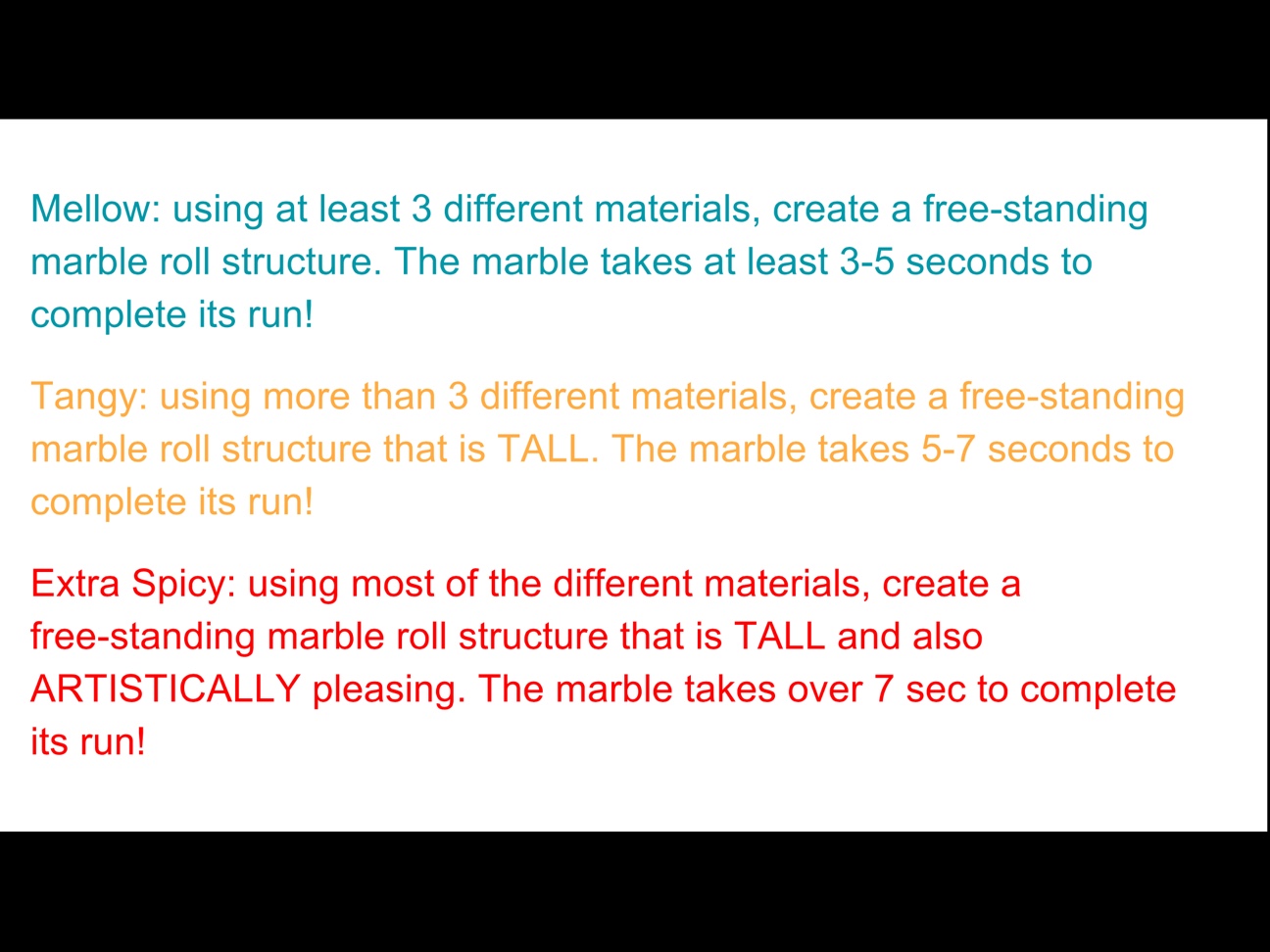
During our last STEAM Challenge (last Thursday) students were asked to create a free-standing slow marble roll...

That was also TALL and ARTISTICALLY pleasing


Here were some of the marvelous creations!


You will notice the active application of art elements: colour, shape, line. 

As to results, here's the tally!

A&J     85cm                  3 seconds
K&E     100cm             16.63 seconds
L&E     30cm                 8.61 seconds
M&L     73 & 75 cm      4.69 & 12.13 seconds
R&H     72cm                5.85 seconds
M&B     82cm              11.97 seconds
L&N     110cm              4.17 seconds
A&B&B  52cm             5.30 seconds
K&G&C   140cm          7.77 seconds
N              77cm             9.11 seconds
C&N         77cm             4.33 seconds
C&F         20cm              4.58 seconds

I'm thinking a scatter plot would be a great way to show this data! Let's create one this week!
  

ART: Observational Drawings

On Saturday, I had the pleasure of attending an ART PD session that focused on a topic I was keen to learn more about: observational drawing.

Our visual arts program is very much about NOTICING. For example, we have started really noticing how artists use the various elements of design (like line, shape, etc) to create a mood/feeling/message. (This will lead us towards a sophisticated and complex analyses of artistic works. See the visual arts page for more details!)

On the flipside, we, as artists, need to start noticing our own choices around the elements of design (in other words, become more self aware of how we use them).

This involves developing a more conscious 'artist's eye'.

Nothing helps develop that artistic eye quite like observational drawing.

In my drawing examples here, you will see how I first drew the person sitting across from me as something like a cartoon. I was looking at her, but not really picking up the finer details.


In the second example, I had to draw her by looking really closely...and I wasn't allowed to peek at what my hand was doing! I was just to pick a point, and let my pencil follow where my eyes went...

In the third example, I was asked to draw the person across from me again, but I needed to go slowly and, while I could peek at what I was doing, I had to mostly keep my eyes on my subject...

The third example is the one that is more specific, more finely detailed, less cartoony, and more authentic.

Each session took ten minutes. So I went from drawing #1 to #3 in about half an hour.

Observational drawings help build our 'seeing' and 'noticing' muscles. They are like scales for musicians...the more you do, the better you get. You don't have to do a lot of them, but if you do them consistently, over time, your ability to notice will improve!

It can also be very relaxing. :)

Needless to say, once our sketchbooks arrive, we will be doing some observational drawing in our class.