Pages

Showing posts with label writing. Show all posts

Wednesday, 7 March 2012

Showcasing Student Writing!

I am finally getting to this project, which has been on my mind for a while...an online class writing portfolio!

This is partly for parents, so they can see student work. I currently don't send home completed writings. Instead students keep all their writing in one book/folder, so they can notice progress and trends in their work over time. It's important to keep all this work, as part of the reflection process inherent in writing. This writing book will go home at the end of the year (but in the meantime, check out a few samples on the online portfolio!)

This is also for students, so they have a broader audience for their writing...it isn't just for the teacher, you know! Your parents, your peers, and other educators (who are, frankly, curious and intrigued by some of the projects we have been doing, like the gaming reviews!) might like to see what's going on, the different writing styles, opinions and approaches.

And knowing you will be 'published' for a wider audience is a great motivator!

This online portfolio is really no different than hanging class work in the hallway...though it allows parents and others easier access. They don't have to come to the school physically to view it!

Please note that I keep it quite private, however, in the sense that I only use student initials and I do not include grades or teacher comments. That is private to the individual. If parents would like to discuss the work on display in more detail, please do not hesitate to contact me!

Also please keep in mind that this is a work in progress...I do not yet have all students, or all examples, on the site. I will email parents once this is more conclusive.

I just wanted to explain and share the idea!

Regards,
Julie Johnson

Thursday, 1 December 2011

Reading Comprehension...Where's the Beef? Take 2!

Students, take a look at this video! Why am I showing it to you, after today, do you think?

As I mentioned in a previous post a while back, in relation to student writing, there has been a need for more 'beef"...in other words, more specific details! (At that time, I referenced the Wendy's commercial from 1984.)

Since then, we have, in our reports and review writing, been working dilligently to add MORE BEEF...in other words, more specific details (which are to be well organized with transition words, such as 'first', 'next', 'then', 'also', etc).

However, as we are doing reading comprehension activities (for example, reading a game review and trying to explain the author's opinion by quoting details from the text), I find myself asking the SAME question as I peruse student answers...

STUDENTS, WHERE'S THE BEEF?

A reading comprehension task is, if you think about, a writing task because we usually ask students to WRITE their answer down. The same rules thus apply! All those skills we have been sharpening in our writing tasks work here too! Give me specific details (using those transition words to organize those details)! GIVE ME MORE BEEF!

Also, when reading other people's writing (especially non-fiction writing like this game review...which is, at heart, an essay) you will often find that those writers have themselves CREATED A BEEFY HAMBURGER!

So where should you go, highlighter in hand, to look for the BEST, JUICIEST, MOST SPECIFIC DETAILS?!

In the middle of the text...where THE BEEF is!

Most students at this school are familiar with the 'answer sandwich' when crafting a reading response (aka., the 'answer hamburger').

Students, writers of all types use this approach when crafting THEIR writing!

Their main idea or argument/opinion is the top bun. THE BEEF or MEAT of the sandwhich is their supporting proof/details. The conclusion, which is a re-iteration of their main idea or argument/opinion, is the bottom bun.

When you are looking for the main idea/argument, go to the buns.

When you are looking for good, supportive quotes and details, as we are now...GO TO THE MIDDLE, WHERE THE BEEF IS!

Go to the middle to get the best proof you need!

Friday, 25 November 2011

Game Review Wrap Up! Lego Batman & Just Dance!


This week we completed our critique of  video games in preparation for our next writing assignment: game reviews.

A while back, we played & critiqued New Super Mario Bros Wii...we also read a review of the game written by Luke Navarro.

This past Wednesday, we played & critiqued LEGO Batman for the Wii...and read this review of the game by Hilary Goldstein.

Today, we played & critiqued Just Dance #1 for the Wii...on Monday we will read a corresponding review.

On Monday, students will also begin writing their own game reviews. They can choose either one of the games we looked at in class or one from home. If they choose to review one from home, they need to take home the graphic organizer THIS WEEKEND and bring it back on Monday. All students were informed of this today.

When we critiqued the games in class, we all used a graphic organizer. This organizer will help students write the review. The organizer included providing descriptive words about the game, game play summary, the effectiveness of the controls, sound, graphics and multiplayer features (and justification for whether you thought they were effective or no), personal connections and the final rating.

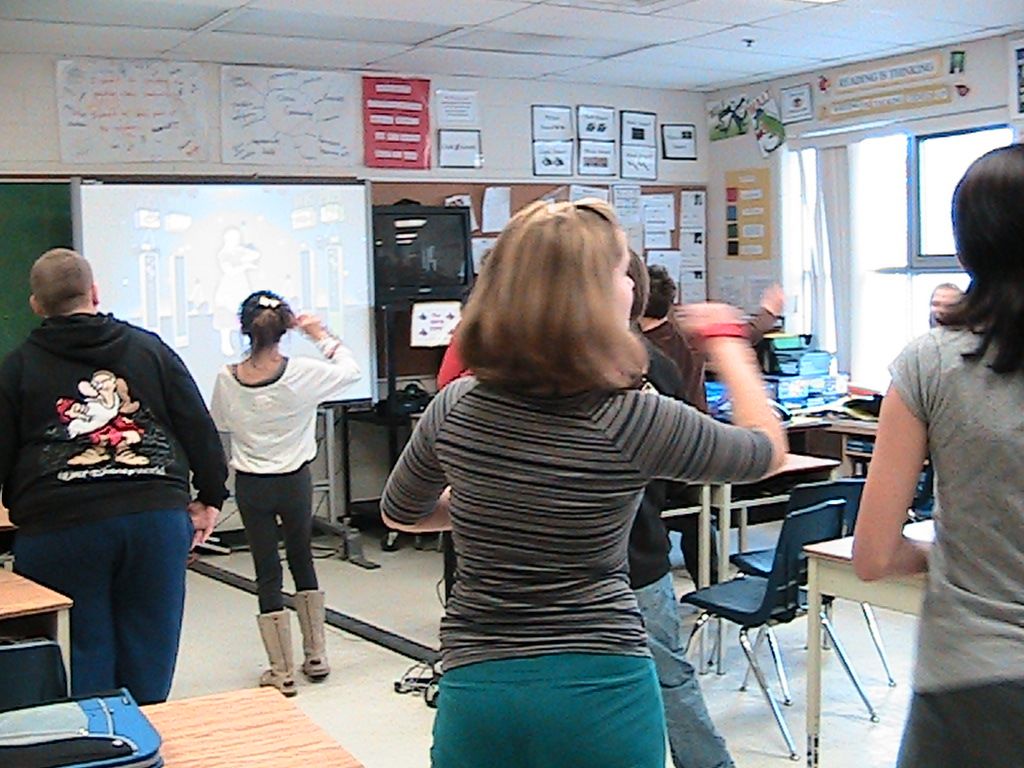
JUST DANCE was a great way to end this week and this unit! Many students gave this game a 10! By the end of the class, even non-players were up dancing! (Who says learning can't be fun?! In fact, I kept hearing that all morning: 'This is so much fun!' 'Can we do this again sometime? It was so much fun!') This was also a great community builder & some students really got a good work out!


Tuesday, 8 November 2011

Reading About & Meeting Luke Navarro! THANKS LUKE!

Today two interesting things happened in our gaming & literacy unit...first, students read this review by Luke Navarro about the game we just played (New Super Mario Bros Wii). Students had to explain why Luke gave the game the rating he did, quoting details from the text. They also had to explain if they agreed with him and why.

Reviews are all about opinions...and you can have any opinion you want but your opinion WEIGHS MORE if you can back it up with substantial reasoning. So what was Luke's reasoning?

After reading and answering questions about the review, students got to meet the author! Through the magic of Skype, Luke spoke with our classroom from his home in California. Students had paired up and prepared questions for him. One student got to come to the microphone at a time & ask the question, while the other wrote down the answer. The written responses will form the basis of our upcoming news report.

In addition to writing gaming reviews, Luke also reviews movies and books (check out guyscanread.com for his weekly book podcasts).  However, our focus today was exclusively on gaming!

Many boys were interested in hearing Luke's opinion about COD, which was very exciting. COD enthusiasts seem to have their own language...and I personally think it was cool for the boys in our class to meet an adult that could speak that language (I personally do not speak COD)...not to mention that he writes about such things (and guess what guys? He likes books too!). This is one of the reasons I think Luke is a great role model. He demonstrates that it is possible to enjoy video games AND books and that one can think critically and intelligently about both.

I'm convinced that if COD were a part of the curriculum, we have student experts who would not only ace that class, they would be able to teach it! Part of my motivation in having Luke as a speaker is to validate that interest and to draw that interest into literacy.

Luke made the statement today that video games are 'art'--a sentiment with which I wholeheartedly agree. Not every one in the class did, however, and I would love to continue the discussion on whether video games are indeed a 'low' form of entertainment compared to books...or not.

One of my goals as an educator interested in games based learning is to prove that there are more things similar than different between books and games. We may have Luke back again as a speaker to explore this concept further!

Again, thanks Luke! We appreciate you taking the time on your Tuesday morning to discuss your reviews & gaming!

Monday, 7 November 2011

Gaming in Literacy

Those of you who know me, or have read my bio page, understand my interest in games based learning.

Please check out my MISA funded research Mario Kart project from last year, and also  my resource page, which shows how other educators are using video games in the classroom.

I was also interviewed CBC radio (and other radio stations) and also by various newspapers.  You might also like to read my blog Using Video Games At Home For Learning Over The Summer.

I'm very excited to bring gaming to our literacy program. Today, we played and critiqued the Wii game New Super Mario Brothers Wii.

Pulling names randomly, students were invited to the front of the room to play the game. Each game session lasted about a minute or so. After each session, we filled out a section on our brainstorming sheet as we prepare for review writing.

We were looking at: finding 5 descriptive words about the game, explaining & summarizing the game play, determining the effectiveness of the controls, the sounds (music, effects, voice), the graphics, and the multi-player function (and justifying those opinions). We also looked at personal connections to the game and then every one gave the game their individual, overall rating.

These points will make up the criteria of our review writing.

Students got quite impassioned in their opinions. Some thought the game too childish (for which they had to JUSTIFY their positon--for example, the graphics are too much like a cartoon, the game play is too easy) while some thought the game one of the best, ever (for which they had to JUSTIFY their position--for example, the music is happy & well suited to the sense of the fun that the game provides).

One thing we have been emphasizing in our reading & writing program is the need for SPECIFIC DETAILS (see previous article 'where's the beef?'). Whether writing reports or answering comprehension questions about Poe's The Tell Tale Heart, students have been encouraged to put in specific details and to justify  their responses with details from the text...or in this case, the video game.

Int his unit, we will be reading game reviews and studying the way writers write reviews (one of these writers is our guest speaker, Luke Navarro). And of course we will continue to play games and critique them! The final assignment will be a review of a game of student choice, either one covered in class or one from home.

Later in the year, we will apply these same strategies to the more traditional movie & book review process.

Sunday, 30 October 2011

Sponge Bob's The Tell Tale Heart & Halloween

Tomorrow we will be celebrating Halloween with a party...so come in a costume if you like! And if you are bringing treats, please make sure they are nut free!

Also note...we will be doing some work in the first half of the morning (party is in the second half). This 'work' we are doing involves using your best Mr. Krabbs, Squidward, and Spongebob voices...as we will be reading the script to Sponge Bob Squarepant's version of The Tell Tale Heart.

This means that the writers of Sponge Bob, like you, have read Poe's story...and were so inspired by it, they adapted it to an episode!

Here is the script we will be reading...and comparing to the orignal.

If we have time, we will also watch the show. If not, that will take place on Tuesday.

See you tomorrow!

Saturday, 22 October 2011

Coming Soon....Spelling


Spelling is one of those things students (and adults like me) find boring and tedious...but it MUST BE DONE! 

First: as a MATTER OF PRIDE. Your ideas are important and deserve the respect of being properly presented.

Secondly: because you don't want to IRRITATE YOUR READER. If you spell words wrong (especially common words) your reader will notice the errors and it will irritate them--especially if it is so poorly spelled, they get confused as to your meaning.

As we have been talking about, writers want to entice readers to keep reading their writing. They don't want to annoy or frustrate them so they toss the writing aside and yell in aggravation: "I'M NOT READING THIS! THE SPELLING IS SO TERRIBLE I CAN’T UNDERSTAND IT! I GIVE UP!"

In this class we will be looking at the 200 most commonly mis-spelled words in the English Language (starting with the top 31). I myself am guilty of mis-spelling these words on occasion (though I am a novelist in my spare time, and I love writing, spelling is not my strong suit. I must work hard at this like most other people do).

These are the words that we use again and again and that readers will notice when we get them wrong.

So let's get them right! Together, we are going to ace these words!

Wednesday, 19 October 2011

Report Writing

Our first main piece of writing is almost completed and will be sent home shortly (for most people, via email). I will also be sending home the initial baseline writing sample so you can compare the two and note the progress.

This first piece of writing is our reports on Chris Simon's visit to our class at the end of September.

We have been approaching this as both a modeled and shared writing task. In other words, we are building it sentence by sentence with direct guidance and input from me and with student suggestions.

One of main priorities in this task is to 'add more beef to the hamburger' by including as much specific details as possible about the who/when/where/what/why and how. We are also 'spicing' up the hamburger by including a variety of sentences (question, statement, exclamation). Our organization should also be greatly improved through the use of specific transition words to organize the paragraphs.

There is, of course, still autonomy to the task: students are choosing what type of question to use as their opening, how they want to write the when/where/who/why/how, which transition words, which questions/answers from the interview and interesting facts to put in the 'what' section, where they want to put their exclamation points.

I am merely breaking it down into specific, smaller tasks, and providing examples and resources (such as transition word lists and spelling lists).

I am expecting through this task that the writing they produce should be significantly improved than their initial baseline piece. My expectations will increase (and increase more for the Gr. 8's vs. the Gr. 7's).

The next report (on Luke Navarro's interview in November) will be more independent, a chance for me to see if they can apply these skills on their own.

Please let me know if you have any questions.

COMING UP NEXT! Writing game reviews, a report on our interview with Luke Navarro...and then main idea paragraphs which will turn into essays in the Winter time as we study Romeo & Juliette!

Also coming up very soon...spelling the top most mis-spelled words!

Independent Writing Journals

Having now seen samples of student writing, I can see that there are common areas of need. Previously, in a post about 'where's the beef?' I spoke of the need for more substance: in other words, adding specific detail and vividness to your writing.

The other area of need is Writer's Voice.

What is Writer's Voice? It is the spark of personality in a person's writing. It is the enthusiasm or mood. It is the emotional connection the writer brings to the writing so that the reader feels it too. To many students, I am advising: 'make the moment come alive for your reader'! Not just through providing basic details but through providing details related to feeling and atmosphere.

Here is another interpretation of 'where's the beef?'. The writing is not only missing detail as 'the beef' but also EMOTION. All I'm being served is a white fluffy bun...blah, how boring! Give me a big, juicy hamburger with all the fixings! A dash of hot sauce! Basil! Fancy gorgonzola cheese! Give me so many onions on top I can't help but cry!

Spice it up! Make the moment come alive for your reader.

I get the sense for many students that writing has become rote. Yes, there are formulas to certain writing forms.  Yes, you need a title, a main idea, supporting details, headings, etc. But you can still, within that framework, add some jazz and some spice and some of your personality to the mix.

To encourage a sense of expression, I have introduced Independent Writing Journals. These are free writing journals. Students are given a topic or prompt (see the new Writing Prompt page for examples), or they can choose their own topic. The objective is to explore it freely through writing, vering off topic as the energy of one's interest shifts. You write for 10 minutes straight, just getting it down, not worrying about anything but connecting to your ideas via the pencil and page. (I also allow picture/caption and comics/graphic stories as a part of this process).

We need to flex our expression muscles and feel our connections to topics so that we can bring it to bear on our more formal writing pieces.

Thursday, 13 October 2011

Kevin McGill puts us on his blog!

Kevin McGill also wrote about our collaborative initiative (which I wrote about in the previous post) on his blog: http://kevinmcgill.wordpress.com

You may also wish to scroll down to see his new BOOK COVER! His book will soon be coming in paper form! (The old fashion way!)

Currently, I read his book as an e-book with my e-reader (kindle).

We have been talking in class about CATS (Cover, Author, Title, Skim or Summary) as a way to discuss and approach books.

Check out Kevin's book cover to see what impressions you get about the book! Can you make any predictions about the book? What do you think about the cover art?

Wednesday, 12 October 2011

Nikolas & Co: Achievement "Unlocked"!


    Kevin McGill, the writer of Nikolas & Co, wrote our class a letter after seeing your visual doodles about his book!

    To Mrs. Johnson's grade 7/8 students,

    • Your teacher, Mrs. Johnson, just showed me your pictures of Nikolas and Company and all I can say is, awesome! 

    • I am so impressed by your drawings and desire to read that I've decided to make it worth your while. 

    • There are so many things about Nikolas and Company that you don't know yet. 

    • Like the power of jynn'us - every person has a power hidden inside all of them, and when they breathe the air of Mon, it will be unlocked. 

    • Some have the power to call weapons out of thin air, others can destroy an entire airship with the blink of an eye. 

    • Then, there's all the various kinds of fantastic creatures: creachlings, elflings, fairlings, humlings, unlings, biglings, midglings, and plantlings. Each kind has their own set of creatures and monsters.

    • For example, under the plantling kind, there is a terrible monster that is part tree and part spider. (A hint: Don't be fooled by one of its juicy looking fruits.) 

    • Would you like to be the first to know more about the thousands of different creatures and inner-powers? Well, you will. 

    • For every week that you listen to and draw along with Nikolas and Company, I will unlock another Mon mystery on my website just for you. 

    • Simply visit http://nikolasandco.com/ and click on "Mon Mysteries."

    • Read on! 

    • Sincerely, 

    Kevin

    Thanks Kevin! I will be sure to let you know by the end of each week if we've got doodles! And if we do I will post them on my new page on this blog dedicated to the Visual Doodles! 


    What an exciting way to explore the creative universe of Nikolas & Company. We look forward to 'unlocking' this special content as we read and think our way through your book!


    Saturday, 1 October 2011

    Where's the Beef? Explained.

    Parents, today, we reviewed the Where's The Beef? commercial and students rightly guessed that, in terms of their writing, I was looking for more substance. I'm looking for more hamburger in the bun!

    In particular, I am looking for specific details. Writers need to paint pictures in their readers head. Give me, your reader, a clear, specific vision to hold onto! If you add more specific detail to your communication--no matter what writing form (letter, story, report, review, essay, etc), your writing will vastly improve.

    This does not mean just giving more sentences. If those sentences are 'vague', it won't improve the writing. This is one of my writing mantras: longer writing does not equal better writing! You can have pages and pages of bad writing. You can have a tight 5 line paragraph of good writing. I want the good writing!

    I have given students these small booklets I call Idea Books or Response Journals. They do not allow for a lot of writing per page. Some students are a bit confused by them. Don't teachers usually ask you to 'write more'? Aren't we supposed to be writing paragraphs? Aren't we supposed to be writing essays?

    We will. But first I think we need to look at quality. We are going to go line by line, even word by word in some cases.  Instead of just saying 'a student', 'a boy', 'a school', get specific. Give me 'female dance student, age 6', 'Freddy from ICarly', 'Hogwart's School of Witchcraft & Wizardry' . I now have a much more specific idea in mind.

    When you are writing summaries, or providing proof in main idea paragraphs, the same idea holds true. The more specific proof or example you give, the stronger your argument.

    We discussed this quote as well (also on the daily quote page): "When asked 'How do you write?' I invariably answer, 'One word at a time.'" Stephen King, famous author, writer of 49 novels.

    Writing is built word by word. As we start our first writing assignment (news report), we will be breaking it down. What is your first line? What is a good first line? How can you improve that first line? What do you put down next?

    This need for the right amount of detail will be looked at all year long even though the writing forms will change over time (reports, reviews, main idea/persuasive paragraphs (fall), comparative essay on Romeo & Juliet, short story (winter), poems, procedures (spring)).

    Let's go create high quality hamburgers!

    Wednesday, 28 September 2011

    Writing Checklist

    Students, you will be using this to review your own work and the work of your peers. I will also be using it to assess your work.

    CLICK HERE to see the checklist.

    Tuesday, 27 September 2011

    Where's the Beef?

    Students, a while back you wrote two writing pieces for me so I could have a sample of your writing ability: a report of a life event and a review of a game, book or movie. I specified a few criteria for each writing form (report needed who, what, when, where, why, how while the review needed a rating and criteria).

    I left the rest of my expectations purposefully vague as I wanted to see what you would produce on your own, without instruction. This acts as a baseline, so I know which writing traits you naturally and intuitively 'know' and those that you don't.  Then I can provide the direction/guidance you need in order to ascend in your writing levels.

    All of you will receive specific feedback on what your areas of improvement are (and that will continue to happen from this point onward).  (Also note that your parents will also receive this information. Many parents expressed to me at Parent Night that they want this information so they know how you are doing.)

    Remember that everyone is at different levels in their writing, and just like in video games with your individual gamer profile, so you each have your own *individual writing profiles*.

    However, there are commonalities in our writing profiles and so we will be starting with those common areas of need.

    This video is meant to address one such area of need. It is a very popular Wendy's commercial from the 1980's. Can you guess why I am showing it? How does it relate to your writing?

    Monday, 26 September 2011

    Guest Speaker: First in our 'Real World Writer's' Series!

    We will soon have the pleasure of our first guest speaker in my Real World Writer Series: Chris Simon will be in our class on Wednesday morning. Chris is the editor (and reports for) the Innisfil Scope. I met Chris last year when he interviewed me about a couple of my projects: my Wii math & literacy project and my J/I boy's literacy event.

    These are listed on my media page.

    Since we are studying report writing, it only made sense to go to an expert & find out the scoop!

    Students will be interviewing Chris on Wednesday and then writing a report about the event.

    We will be putting our interview & reporting skills to use all year long as we interview other Real Life Writers.


    WALT: write a news report, using expected criteria
    WALT: speak effectively and listen attentively, evaluating these abilities in self & others

    Thursday, 15 September 2011

    Writing 'Baselines' & Math Charades

    BASELINES
    Today, students had a choice in writing tasks: write a news report about an event in their life OR write a review of a game, movie or book. Over the next few months, we will be developing our skills in report and review writing but for now I just needed a 'baseline'--an idea of what their writing is like before teacher intervention & instruction. This will let me know everyone's 'starting point' and their areas of need for growth. We will work on growing the quality of their writing over the year. What they write for me today should look very different from a sample at the end of the year. (ie: It should look better!)

    MATH BOOSTER
    We also started something today that I call 'math booster' and this will be a weekly component to our language program. Ms. Scigliano teaches math in the afternoons but as a 'support' to those lessons I will be integrating math into the language curriculum. In my language program, one of my over all goals is to students to 'creatively and clearly communicate concepts." In this math booster class, students will creatively and clearly communicate MATH concepts using a variety of methods: oral presentations, writing (short stories, explanations, journals) and media (video creations, bitstripsforschools, etc).

    We started with some fairly straightforward concepts today but the tricky part was figuring out how to portray them as 'gestures only' with a partner ('math charades'). So the concept of 'fractions'. for instance, was portrayed by a pair of students as miming cutting up a pizza or circle into pieces. Students reviewed the performances and were assessed on their listening skills (a component of their oral language curriculum).  The audience's job was also to guess the math concept being presented.

    I hope by this example you can see how in this math booster session we will be looking at math through a variety of 'multiple intelligences', expressing it through gestures, picture & images, sounds, words/texts, as well as the traditional 'number' format. I'm hoping this approach will encourage a deeper understanding of math and also provide a venue for creative literacy expression.

    The math concepts will, of course, grow in complexity over time... stay tuned!

    Wednesday, 14 September 2011

    Bitstrip: Class Portrait

    Today we got to go back into bitstripsforschools.com with the laptops. Everyone now has an avatar. Here is the completed class portrait!

    WELCOME TO MRS. J's CREATIVE COMIC CREATORS!

    We are working on some additional writing projects using this comic creation site...so stay tuned! Student samples will be posted!

    Friday, 9 September 2011

    Writing with Tech (Email, Bitstrips) and thinking about Multiple Intelligences

    As you can see, we are a creative bunch.
    Today we had the laptops for the full morning period. Students are provided by our school board with usernames and an email account.

    EMAILING

    Students logged on, and emailed me their writing responses:

    -identify the main idea of the Blue Jays video we watched (a short clip on Brett Lawrie's homerun in their game against the Red Sox this past week).
    -provide 5 words describing the mood of the Blue Jays video
    -tell me the answer to the questions from yesterday: 'who wrote your favourite song,  TV show or movie?' (this also necessitated a google search)
    -tell me one goal for reading &/or writing

    This activity gave students the chance to explore the school email service & write short answer pieces.

    BITSTRIPS FOR SCHOOLS
    We then created student bitstrip accounts. Bitstripsforschools.com is a closed site where students can create and share comics (moderated by me). Today, most students  were able to create their avatar. Some also got started on their first assignment "Introduce Yourself Through A Comic". We will continue with bitstrips next week and throughout the year.

    I am a big fan of bitstrips and have included several of my comics on this site already.

    MULTIPLE INTELLIGENCES
    This poster is missing Nature Smart! And I added Tech Smart.
    Multiple intelligence is a concept from Howard Gardner and it describes the wide variety of ways that people learn or are 'intelligent'.

    In class today, students identified which was their strongest or most predominate skill or 'smartness': tech smart (which I added to the original list because I think it needs to be there), body smart, picture smart, self smart, people smart, music smart, logic smart, picture smart, self smart (and nature smart). They did this by moving around the class room to the sign with their smartness on it. (Interestingly, the tech smart folks gravitated to the computer as they did this task (and we're online, even though they weren't supposed to be. They just couldn't seem to help themselves with the laptop being on & right there close by!), while the body smart folks could hardly stand still beneath their sign!). (That behaviour just proved to everyone that they'd made the right choice!)

    They then had to self-reflect on this choice and write a few sentences as to why they thought this was their main area of smartness (what examples of it are in their life currently in the form of hobbies or activities?) and also to think about career examples that align with their talents & interests.

    We will continue our exploration of learning preference and identity as the year progress.

    Thursday, 8 September 2011

    Using Games & Media to Promote Writing, Among Other Things

    I consider myself to be a creative person. I admire creativity in others & also want to inspire creativity in others. Video games and media have tremendous potential as a means of creative expression and also as a focus for our own engagement and creative thought.

    We used both media & games today in our language class.

    1. Video Games & School: Discussion on Effective Feedback.
    Click here for the prezi version of the presentation I gave today on comparing the effective feedback in video games to the effective feedback in schools. (The original version was on powerpoint and also had Spanish subtitles. If anyone would like that version, please email me. The prezi version is easier for the online community to view so I created it after the fact).

    Your gamer profile in the video game called 'literacy'.
    The point of this activity was two fold.

    First, to discuss the idea of 'effective feedback'. What is it in video games? (tool inventory, health meters, maps, rankings, etc).

    What is it in schools? (report cards, comments, conversations, notes from the teacher, regarding various subject areas & skill sets, etc).

    And, in both cases, what is the purpose? To inform your next steps, to grow in 'gamer points' so that you can proceed to the next level.

    Your 'gamer/student profile' should be different from the start of the year to the end in the various areas. As in the video game, we expect you to grow. Teachers also need to take base lines data (through reading comprehension tasks and writing samples, for example) so we can determine your profile 'starting point'.

    Secondly, as an opportunity for students to provide feedback & also understand oral language criteria. Before the presentation, I gave the students the criteria for 'effective speaking' (part of our Oral Language curriculum). They then needed to rate my presentation based on this criteria. At the end of the presentation, I asked them for their 'feedback'. I also asked to explain why they rated me the way they did.

    They also had to write down the 'main point' of the presentation (in a sentence). Here are some responses:

    • It was about how she wants to improve the levels of our thinking.
    • Her point was that school is kind of like a video game in terms of feed back.
    • It's saying school is like a video game in feedback.
    • She was showing how we start out the year. At the end of the year we should be better.
    This activity generated a lot of interesting discussion about gaming, school, feedback, and game design.  I think it was a new experience for students to 'critically' examine familiar games. (ie: Why did the game designers put those feedback systems in place? They did it for a reason!).

    We will continue to examine all forms of media (and texts) with a 'critical' eye.

    POPLIT
    Today I introduced students to the 'quick write' activities in my literacy/media site poplit.net. This was highly engaging and provoked considerable reaction & response (in both written & oral forms).  We did 30,000 Dominoes, The Duck Song, Dot, and Western Spaghetti.  We will continue to use this site as a way to generate short writing pieces & respond to creative visual 'texts'.

    PS. to further extend this activity, students will be reading this blog post & evaluating how well I 'reported' on the event (we are soon to focus on 'news-report' writing criteria).