I felt like trying out the Star Wars scrolling text feature in iMovie. Here's what I made for our Grade 8 class...
Star Wars: A New Year from Julie Johnson on Vimeo.
Sunday, 6 September 2015

Monday, 31 August 2015
Welcome! September 2015

"ONLY CONNECT"... These two simple words (the epigraph to E.M. Foresters 1910 novel "Howard's End") have stuck with me since I was an undergrad at University studying English in the 1990's.
They sum up the essence of literacy &, I believe, the purpose of school.
We are communicators. We read, we write, we solve, we learn, we share through a wide variety of mediums.
The technology age has only enhanced this aspect of our human nature. We tweet. We blog. We Facebook.
We continue to read, write, learn and share in new ways and as such are becoming digital citizens.
This class blog will grow as this class grows through the year.
Please explore the site & let me know if you've any questions, concerns or comments! I always welcome feedback. My email is jujohnson@scdsb.on.ca.
Julie Johnson
Tuesday, 24 September 2013
Leave of Absence
With regret, I am sorry to say that I will be taking a medical leave of absence effectively immediately.
I hope to return in January upon consultation with my doctor.
I will very much miss
I hope to return in January upon consultation with my doctor.
I will very much miss
Thursday, 19 September 2013
Writing Awesomeness

Students have already written a 'baseline' narrative for me. I asked them to give me a sample of their 'best work'...but I did not give any other specific criteria. "Just tell me about a Life Event", I said (which can be a trip, a hockey game, an afternoon at the beach...). I wanted to see what students would naturally be inclined to produce. What is their starting point?
We set those aside, once completed, and then turned our attention to three samples I provided, each of a particular quality. I asked students to judge those pieces to determine which was better and why.
Students know quality work when they see it. The trick is defining what makes it of better quality.
Through that discussion process, we determined that these are the qualities of an awesome (or effective) personal narrative.
·
TITLE
o Intrigues
the reader, they have questions in their mind, they want to read on
·
STARTER SENTENCE
o Intrigues
the reader, they have questions in their mind, they want to read on
·
DETAIL
o specific,
descriptive, includes 5 senses (touch, sound, taste, sight, smell) as much as possible
o should
be easy to visualize/imagine
·
SENTENCES
o are
various (different types and lengths, not all the same)
o not
just simple and short ones. (Not just 'I saw the dog. The dog smiled')
o Some
are complex. (When I saw the dog, he smiled. In other words, use commas!)
has accurate punctuation
has accurate punctuation
·
WORD CHOICE
o interesting, different, and not boring
·
DRAMA
o Uses
dialogue and sound words like WHAP
·
FOCUS
o is
on one event, which is described in depth
o each
paragraph has its own focus
This will for the basis of the editing process. Students will next turn to their original work and see where they can improved, based on this checklist.
Friday, 13 September 2013
Playing With Point of View

Recently, a very mysterious figure appeared at 'the dredge' (a place full of old mining equipment)' One of the burning questions raised by this books is who...or what...is this mysterious figure and why is it at the dredge?
We spent some time today trying to come up with answers. Students had to create a 'reasonable theory', one that made sense based on information already provided by the text. In other words, if we were the author, what solution would we provide for the reader? How would we resolve the question of 'the mysterious figure'?
Once we determined plausible theories, we then played around with point of view. This story is very much told from particular perspectives: Sarah and Ryan alternate the point of view, through Ryan's journal entries and Sarah's video creations. We have NOT heard from the point of view of the mysterious figure, the 'skeleton' faced figure (ghost? person?) who is such a spooky presence to Sarah and Ryan. What might his/her/its story be?
So today I asked students to write the story from this alternative perspective. This was an informal activity, a quick fun-write for the purpose of initial exploration.
Point of view is an interesting concept we will continue to explore as the year progresses. For example, why do writer's choose a particular point of view over others? What is the benefits to be gained for doing so? What voices are NOT being heard? Are their alternate view points? Etc.
Below are sound clips of me reading a variety of samples. The first three are written by students (but I am the one reading them). I have included my own version at the end, the one that I wrote. Enjoy!
Wednesday, 11 September 2013
Criteria for Awesomeness

But how do you know you've become awesome if you have no way of knowing what awesome looks like? Or where you are in relation to it?
That is why I like to spend considerable amount of time discussing the 'criteria for awesome'. What does 'awesome' look like as a reading response, a summary, a connection to text, a math response, a personal narrative, an essay, an oral presentation, etc. etc? What criteria determines 'awesomeness'?
You may have heard of Levels, such as Level 3 (expected). I like to look at Level 3 and 4 as examples of awesome. I like to have students look at samples of work at all levels (some I create, others I take from previous years, and other are current examples created by students) and have students determine along with me...what defines AWESOME in this situation? How, for instance, is this piece of writing more awesome than this one? What specifically do they do? Let's list it specifically! This list of criteria can then become the base for future student work.
Thus, the path to awesomeness is a clear road. Everyone knows what to aim for, what to do, and, through my guidance, how to get there. Teachers sometimes use the phrase 'bump it up'--I like to say this, too. "How do I bump up and move closer to awesome?" This is something we will be talking about.
Each student also has a Feedback Journal...a book where specific feedback related to tasks is written down. Based on that, students can create individual goals for progress. Students also keep portfolios to track work over time. Reflection is an important part of the process: "how did I do and how can I do better?"
Students can become quite adept at the process of evaluation and can also then use their 'critical eye' to judge their own work (self assess) and the work of others (peer assess).
Criteria for major assignments are posted here on this blog and always in the classroom. Students also receive a copy. I strongly encourage students to use the listed criteria to guide progress!
Wednesday, 4 September 2013
Class Read Aloud

As a class, we made inferences (educated guesses) about the text, modeling what all readers do when they first approach a text. We examined and analyzed the cover design(s), and also looked closely at the first few paragraphs.
We will be using this text to model various comprehension approaches, which students will also do independently when we launch our Independent Reading program next week. We are also using the text to examine 'writing tricks'...how writers convey character, plot/conflict, setting, theme. Today we talked a lot about the sensory descriptions he used to make the fictional world come alive. What images or sensations appear 'in the mind's eye'?
With this read aloud we are able to explore both 'what good readers do' as they engage in a text but also 'what good writers do' to communicate to their readers.
PLEASE NOTE: Some aspects of this book are indeed spooky, a few of the videos in particular. Rest assured that this material is age appropriate. Gr. 7 level is part of the intended audience, the entire series is also available in the general section of our school library (not Young Adult). However, if any students finds the videos too spooky, they are of course allowed the option of stepping out of the class during the viewing. The events of the video can be summarized upon their return.
The reason why I chose this book is because the mystery is VERY ENGAGING! It is 100% NOT boring and students get quite excited and eager to talk about it. It generates high enthusiasm for learning and for having discussions about reading and writing.
Sunday, 25 August 2013
Welcome September 2013!
Only Connect... by JJohnsonn on GoAnimate
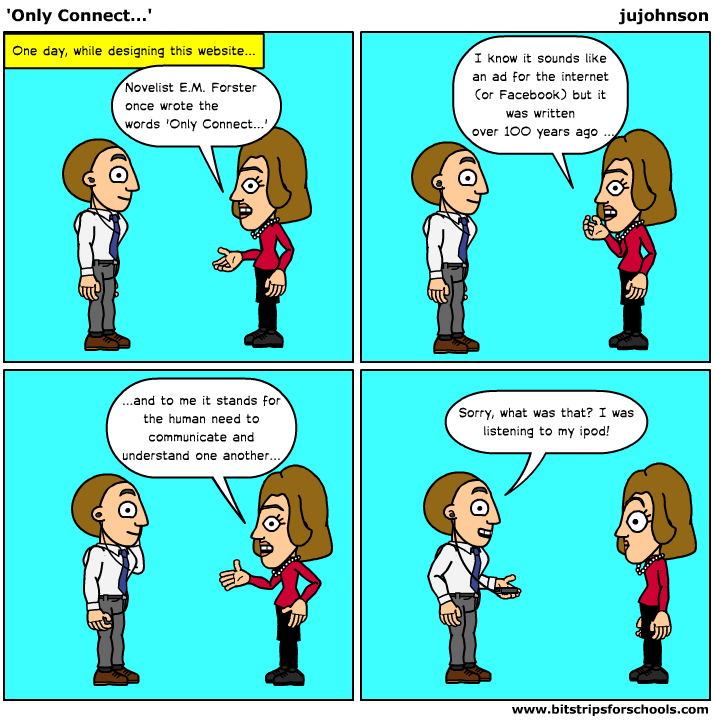
"ONLY CONNECT"... These two simple words, (the epigraph to E.M. Foresters 1910 novel "Howard's End") have stuck with me since I was an undergrad at University studying English in the 1990's.
They sum up the essence of literacy &, I believe, the purpose of school. We are communicators. We read, we write, we solve, we learn, we share through a wide variety of mediums. The technology age has only enhanced this aspect of our human nature. We tweet. We blog. We facebook. We continue to read, write, learn and share in new ways and as such are becoming digital citizens.
I post blogs on a regular basis so be sure to check in often. The purpose of this site is:
- to provide digital connection between myself, students, parents, the community & other educators or interested parties. It acts as an online newsletter for everyone to know what AWESOME learning activities are going on in this classroom!
- to act as a teaching tool in this class as I post & connect learning items. I often post material on this site that I use in the classroom.
- to organize material. I either post links to downloadable documents related to assignments on this blog that can be downloaded from home OR post success criteria and assignment information directly as a blog post.
- to act as a showcase of student work
Please explore the site & let me know if you've any questions, concerns or comments! I always welcome feedback. My email is jujohnson@mail1.scdsb.on.ca.
Julie Johnson, teacher
PS I also created a comic based on the theme 'only connect'...
Friday, 31 May 2013
Health Unit: "Growth and Development"
On Monday, we start our last health unit on "Growth & Development" aka Sex Education.
There are the curriculum expectations for this unit:
OVERALL: describe age appropriate matters related to sexuality (eg. the need to develop good interpersonal skills, such as the ability to communicate effectively with the opposite sex).
SPECIFIC:
-explain male and female reproductive systems as they relate to fertilizations
-distinguish between the facts and myths associated with menstruation, spermatogenesis and fertilization
-identify the methods of transmission and the symptoms of sexually transmitted diseases (STDS) and ways to prevent them
-use effective communication skills (eg. refusal skills, active listening) to deal with various relationships and situations.
-explain the term 'abstinence' as it applies to healthy sexuality
-identify sources of support with regard to issues related to healthy sexuality (eg. parents/guardians, doctors)
For this unit, we will be watching Learn 360 videos based on the above curriculum goals:
If you have any questions about this unit, please let me know.
There are the curriculum expectations for this unit:
OVERALL: describe age appropriate matters related to sexuality (eg. the need to develop good interpersonal skills, such as the ability to communicate effectively with the opposite sex).
SPECIFIC:
-explain male and female reproductive systems as they relate to fertilizations
-distinguish between the facts and myths associated with menstruation, spermatogenesis and fertilization
-identify the methods of transmission and the symptoms of sexually transmitted diseases (STDS) and ways to prevent them
-use effective communication skills (eg. refusal skills, active listening) to deal with various relationships and situations.
-explain the term 'abstinence' as it applies to healthy sexuality
-identify sources of support with regard to issues related to healthy sexuality (eg. parents/guardians, doctors)
For this unit, we will be watching Learn 360 videos based on the above curriculum goals:
- "We're Growing Up" (puberty changes, body processes, hormones/reproductive systems)
- "Am I Normal?" (discusses scenarios requiring decision making skills, STDs, pregnancy prevention)
- "Teens and Sex: What you need to know" (discusses scenarios required decision making skills, STDs, pregnancy prevention, reproductive systems)
- "Straight Talk About Sexual Choices and Consequences" (discusses scenarios required decision making skills, healthy relationships, peer pressure, hormones/emotions, STD, pregnancy, abstinence)
If you have any questions about this unit, please let me know.
Saturday, 18 May 2013
Poetry, Lyrics, and Music Videos as 'Visual Poems'
On Friday we kicked off our next literacy unit: Poetry, Lyrics and Media Study. This unit essential involves investigating song lyrics of modern times, poems from olden times (with comparisons between then and now) and modern day visual representations of both (on youtube and as music videos). It is one of my favourite units and so much fun to teach.
We started with Stereo Hearts by Gym Class Heros. This was a perfect song to start with, especially given it was a Friday before a long weekend: peppy, happy, everyone sings along...and the lyrics have surprising depth. The song is essentially one giant example of figurative language..we studied 6 metaphors/similes specifically, explaining and interpreting them.
That lead us to 'main idea' suggestions: I put 5 on chart paper, that students suggested (most ideas had to do with: 'wanting to love' but also 'wanting to be loved', especially 'for who they are'--even though they are heavy and old like a boom box, and have scratches like an old record').
Then we looked at the music video. Students had to 'judge how effectively the visual representations portrayed the main idea of the text'. To do this, of course, they must interpret the images.
I encourage students to jot down every image they see in the music video...then choose the top 5, the five that seem most important.
We realized the video seems to involve a lot of shadow, it is quite grey in tone, and very 'real world'...the pavement is cracked, for example. Also, why is he so alone? Random people walk by...but where is the romantic interest? He is singing this song to someone, asking if he can love them and asking to be loved in spite of flaws. So...where is this person? Why isn't the video 'more romantic'?
At the end, students had to decide yes or no...was this an effective representation? Most students said no, primarily because it seemed at odds with the idea of love and romance. But a surprising number said 'yes', it was an effective representation...because he is asking to be loved 'as is'...and reality involves shadows and cracked pavement. It's 'not fake'.
Very clever!
Of course, there is no right or wrong answer. It all depends how how well you can justify and explain your opinion, supporting your opinion with evidence from the text.
But it certainly draws forth some interesting conversations!
One reason why I enjoy this unit is because we take such 'mundane' elements of 'pop culture' and realize their intrinsic power. As I told the students, the lyrics they hear on their MP3 players etc are modern day poems. Every time they listen, they are connecting with and interpreting poetry. And the music videos are 'visual poems'.
The idea of 'poetry' often seems so old fashioned to students...when I say we are studying poetry, there are always a few groans. Its like they think that all the poets are from a hundred plus years ago and thus must not have relevancy. Oh, but they do! One particular aspect of this unit I enjoy is taking poems from yesteryear and comparing them to modern day lyrics, such as when I contrast Coolio's Gangster Paradise song (1995) with Percy Shelley's Ozymadias (1818)...and then we look at youtube interpretations of Shelley's poem, created by modern readers...
I truly can't wait to see what my class thinks of that!
PS. I enjoy this topic so much I created a website out of it...see lyrics.poplit.net
We started with Stereo Hearts by Gym Class Heros. This was a perfect song to start with, especially given it was a Friday before a long weekend: peppy, happy, everyone sings along...and the lyrics have surprising depth. The song is essentially one giant example of figurative language..we studied 6 metaphors/similes specifically, explaining and interpreting them.
That lead us to 'main idea' suggestions: I put 5 on chart paper, that students suggested (most ideas had to do with: 'wanting to love' but also 'wanting to be loved', especially 'for who they are'--even though they are heavy and old like a boom box, and have scratches like an old record').
Then we looked at the music video. Students had to 'judge how effectively the visual representations portrayed the main idea of the text'. To do this, of course, they must interpret the images.
I encourage students to jot down every image they see in the music video...then choose the top 5, the five that seem most important.
We realized the video seems to involve a lot of shadow, it is quite grey in tone, and very 'real world'...the pavement is cracked, for example. Also, why is he so alone? Random people walk by...but where is the romantic interest? He is singing this song to someone, asking if he can love them and asking to be loved in spite of flaws. So...where is this person? Why isn't the video 'more romantic'?
At the end, students had to decide yes or no...was this an effective representation? Most students said no, primarily because it seemed at odds with the idea of love and romance. But a surprising number said 'yes', it was an effective representation...because he is asking to be loved 'as is'...and reality involves shadows and cracked pavement. It's 'not fake'.
Very clever!
Of course, there is no right or wrong answer. It all depends how how well you can justify and explain your opinion, supporting your opinion with evidence from the text.
But it certainly draws forth some interesting conversations!
One reason why I enjoy this unit is because we take such 'mundane' elements of 'pop culture' and realize their intrinsic power. As I told the students, the lyrics they hear on their MP3 players etc are modern day poems. Every time they listen, they are connecting with and interpreting poetry. And the music videos are 'visual poems'.
The idea of 'poetry' often seems so old fashioned to students...when I say we are studying poetry, there are always a few groans. Its like they think that all the poets are from a hundred plus years ago and thus must not have relevancy. Oh, but they do! One particular aspect of this unit I enjoy is taking poems from yesteryear and comparing them to modern day lyrics, such as when I contrast Coolio's Gangster Paradise song (1995) with Percy Shelley's Ozymadias (1818)...and then we look at youtube interpretations of Shelley's poem, created by modern readers...
I truly can't wait to see what my class thinks of that!
PS. I enjoy this topic so much I created a website out of it...see lyrics.poplit.net
Friday, 10 May 2013
Guest Speaker: Writer Kevin McGill

Kevin has been a guest speaker for me in previous years and he is always an enjoyable guest to have. He was also one of the presenters during my Junior/Intermediate Boy's Literacy Event a few years ago (which you can read about via news articles here. You will need to scroll down!)
Kevin's has written a young adult series called Nikolas & Co. He also sent his book into space! (For real!)
As an oral language task, students have paired up and determined an interview question for Kevin. Questions could be about writing, books or sending his book into space...but they all have to be unique! During the interview, one student asks the question during the interview, the other writes down the answer. Later, the student who wrote the answer will need to present their response as part of a class podcast, which I will eventually post here.
Thanks, Kevin, for taking the time to speak with us today!
ADDENDUM: As promised, here is the podcast!
Tuesday, 7 May 2013
Oral Language & Media: Travel Presentations

"HAVE YOU EVER WANTED
TO GET AWAY FROM IT ALL? Now's your chance!"
Students, either in pairs or individually, are being asked to research a 3-4 day 'dream vacation' to any destination by plane from Toronto. (No all inclusive packages and no trips to space, please!)
They will present the details as a presentation, which must include two parts:
PART A: TRIP
ITINERARY
Using the internet, they are to plan every detail of their trip including:
-What flight will you take to get there?
-Where will you stay?
-What will you do each day? What sites will you see? What
places will you visit? Is there a particular restaurant you want to eat in? Etc.
PART B: BUDGET LISTS
Students will need to make a list of the real world costs. These
can easily be found on the internet. NO PRETEND COSTS!
Costs to consider:
-airfare for each
-hotel costs for each (everyone gets their own room)
-daily living costs, if possible (breakfast/lunch/dinner)
-costs for any outings (such as admissions to museums,
movies, sporting events, tourist attractions, etc)
-travel within the city or day trips (train fare, bus fare,
etc) if applicable
-any other costs! (souvenirs?)
These are to be added up to show a total cost.
A few points:
-students are not to give any personal information out for any reason
(like name or email)
-flights must leave from and return to Toronto
-if a flight does not leave on a Friday then pick any 3
to 4 day span (or whatever time frame works)
-no ‘all inclusive’ packages!
CRITERIA (Oral Language)
- demonstrate an understanding of appropriate speaking
behaviour by using effective presentation techniques (eye contact, volume and tone, etc)
-communicate
orally in a clear, coherent manner,
-use appropriate words, phrases, and terminology related to their research
-both participants must speak equally during the presentation
-the presentation is max 5 minutes in length
-the presentation has a media component (such as powerpoint, Prezi)
CRITERIA (Media)
-include a budget list documenting the costs of your pretend
weekend/long weekend trip, with a TOTAL COST included
-include photos, videos or sound clips that represent your travel plans
-include an itinerary of events (what you plan to do on your trip)
-spell common words correctly
Narrative Writing

Here are some ideas I proposed to get them started:
-use one of the stories you started
during our literacy centers.
-use the ‘narrative cue cards’ to
determine your plot, characters, setting
-write ‘fan fiction’ (choose a
famous story, text/movie/media: Harry Potter, One Direction, Twilight, Mario
& Luigi, Minecraft world, Star Wars, etc and write a story based on those
characters and in that setting).
-write within a genre: mystery,
fantasy, spy, ghost story, etc.
-play with Point of View: write
from an unusual perspective! An inanimate object, a tree or natural object, the
viewpoint of a villain like Darth Vadar, a Creeper etc)
-come up with your own idea!
CRITERIA
-include a SUPER first sentence to interest the reader
-include obvious setting and characters
-include a plot with a clear problem and solution
-use vivid description that engages the reader’s senses (sight, sounds,
smell, etc)
-use interesting words (no boring words like 'good' or 'bad')
-use dialogue to add drama
-include an interesting title that makes the reader curious
-spell common words correctly
-spell common words correctly
Subscribe to:
Posts (Atom)