Pages

Tuesday, 18 September 2012

Oral Language: Continuing with the Main Idea!

We continue to work on explaining the main idea in oral texts. Today we watched Kevin Alloca's oral presentation on "Why Videos Go Viral" from TED TALKS.

This is a great presentation...and we will be turning to it again, particularly when we start creating full persuasive essays, as he provides an excellent model of a persuasive essay format (you'll notice he provides an argument, supports that argument with 3 key points which are in turn supported by clear evidence/proof and then thoroughly explained...but that is something we will explore later in more depth!)

The focus of today was to again note down a speaker's key words and then look over those words to determine what is MOST IMPORTANT. What is MOST IMPORTANT typically leads to the overall main idea. When writing about the main idea, it helps to use those KEY WORDS in our explanation because that keeps it very SPECIFIC. One of our goals in explaining our understanding of an oral text is to be very specific to the text and also to be very CONCISE and to try to explain ourselves in one sentence.

I like to combine oral language and media studies because typically when giving an oral presentation people use media as well (such as a powerpoint or prezi) to clarify their ideas. In this talk, he puts key words on screen. Students, this is a clear indication that they are important! Not only is he saying them, he is showing them as well. He is emphasizing them.

Student will eventually be giving presentations of their own. It is helpful to see a model of a good presentation.

Also, the work we are doing now in crafting specific and concise main idea sentences will impact later study in literacy--for when we start explaining the main ideas in our readings, for example (also known as 'themes' in works of fictions), or when we start developing introductions to persuasive essays. The skill of being specific and concise is one that is needed time and again in the process of communication--whether we are speaking or writing. This is our first foothold in the development of that skill!

Tuesday, 11 September 2012

New: Math Page!

I have added a math page to this class blog. If you look along the top row of my blog above, you will see the MATH tab. The link is also HERE.

Please take a moment to check out this page.

I have included many links that explain the new direction of math teaching that I will be taking. This direction is one that emphasizes math thinking (aka the 'math processes), creative problem solving and math communication in many forms (talking, writing, reading, drawing about math).

This approach takes math beyond the textbook and beyond the simple right answer/wrong answer or right solution/wrong solution. My role is to act as a guide or facilitator to assist students in exploring math concepts and methodology with an emphasis on math's BIG IDEAS.

To learn more about this approach, please check out my math page links.

On my Math page you will also find a list of our math goals which will be updated monthly.

I also list our plans for each math class. This is primarily to organize myself in class (I use this blog every day in class as a daily agenda and as a form of communication. It takes the place of chart paper and blackboard). However, you are also welcome to read up on what we are doing daily, keeping in mind that this is a rather fluid process.

I love the class blog as a means of communicating daily class practise. I am a big believer in making the classroom transparent...what goes on here should not be shrouded in mystery!

No longer can your child say 'nothing' if you every ask your child what they did in school today...because all the details are on the blog if they need to refresh their memory!

Friday, 7 September 2012

Spelling


Spelling is one of those things students (and adults like me) find boring and tedious...but it MUST BE DONE! 

First: as a MATTER OF PRIDE. Your ideas are important and deserve the respect of being properly presented.

Secondly: because you don't want to IRRITATE YOUR READER. If you spell words wrong (especially common words) your reader will notice the errors and it will irritate them--especially if it is so poorly spelled, they get confused as to your meaning.

Writers want to entice readers to keep reading their writing. They don't want to annoy or frustrate them so they toss the writing aside and yell in aggravation: "I'M NOT READING THIS! THE SPELLING IS SO TERRIBLE I CAN’T UNDERSTAND IT! I GIVE UP!"

It is an expected part of the grade 7 curriculum that students are able to spell common words correctly. In this class we will be looking at the 200 most commonly mis-spelled words in the English Language as our starting point.

I myself am guilty of mis-spelling these words on occasion (though I am a novelist in my spare time, and I love writing, spelling is not my strong suit. I must work hard at this like most other people do).

These are the words that we use again and again and that readers will notice when we get them wrong.

So let's get them right! Together, we are going to ace these words!

Wednesday, 5 September 2012

How School is Like A Video Game...

As you will see in the side bar, I like to list the current focus for each month so everyone knows what we are doing and what we are  planning to do in the near future. September to me is all about establishing where students are at vis a vis the various curriculum areas and setting goals from there.

Once I know where students are at, I can give feedback to guide them in obtaining the skills that they need to progress. I presented this idea to the class this week in a cute little analogy that compares Video Games & School. Students were also asked to write down what they thought was the main idea of my presentation (thus, providing me with data on their ability to demonstrate an understanding on an oral text--a key component of the oral language curriculum!)

A Screenshot of a Gamer Profile: Zelda:
This is the prezi I gave on comparing the effective feedback in video games to the effective feedback in schools.

A Screenshot of a Student Profile: Literacy
The point of this activity, as I mentioned above, was two fold.

First, to discuss the idea of 'effective feedback'. What is it in video games? (tool inventory, health meters, maps, rankings, etc).

What is it in schools? (report cards, comments, conversations, notes from the teacher, regarding various subject areas & skill sets, etc).

And, in both cases, what is the purpose? To inform your next steps, to grow in 'gamer points & skills' or student ability and skills so that you can proceed to the next level.

Your 'gamer/student profile' should be different from the start of the year to the end in the various areas. As in the video game, we expect you to grow..but instead of growing in health hearts, we want growth in curriculum areas. Teachers also need to take base line data (samples of reading, writing, oral language, spelling, math ability at the start of the year so we can determine your profile 'starting point'. This provides a point of comparison so you can see your progress over time!

Secondly, to see if students could aptly explain the main idea of my oral text!

Most students were able to explain afterward in writing that my talk was a comparison between school and a video game, or they noted that both were about progressing...but it was clear from these student samples that they could grow in this ability. Most students in this class need to work on these skills when answering a comprehension question about an oral text:

-restating the question (the main idea is...)
-being more specific ('games and school are the same in many ways'...should include more specific details other than just saying 'many ways'!)
-being more concise! (some students were repetitive, and wrote their response over many sentences. The main idea should fit into one sentence! It can be tightened up!)

Students have now set personal goals based on my feedback.

I realize I have gone into a fair bit of detail here about baselines and this first baseline sample but I want to demonstrate how the process of obtaining a baseline sample and providing feedback based on clear criteria helps students know which skill area to focus on next so that they improve in those abilities.

Just as a map on the Zelda game screen tells you where to go next, so too do I, as your teacher, tell you where you need to go next so that you may progress!

Monday, 27 August 2012

WELCOME SEPTEMBER 2012!


GoAnimate.com: Only Connect... by JJohnsonn

Like it? Create your own at GoAnimate.com. It's free and fun!

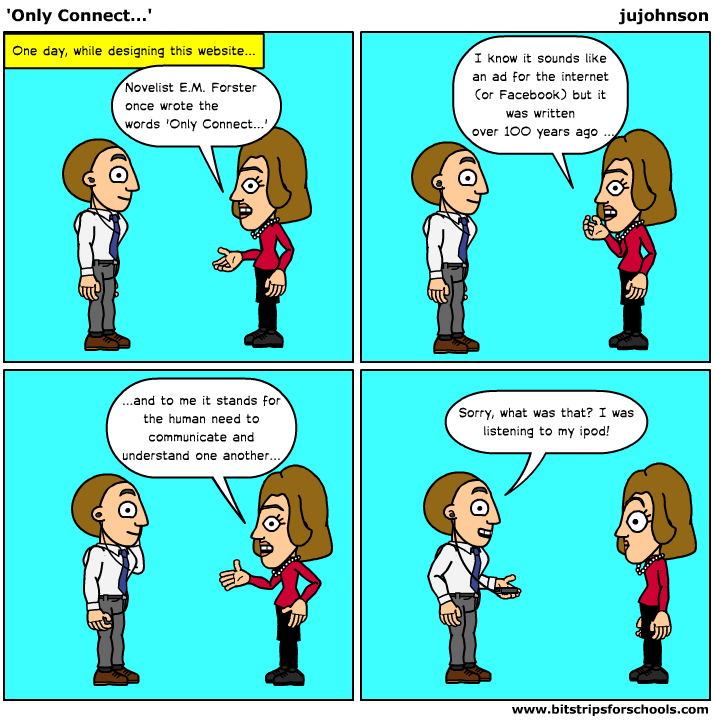
"ONLY CONNECT"... These two simple words, (the epigraph to E.M. Foresters 1910 novel "Howard's End") have stuck with me since I was an undergrad at University studying English in the 1990's.

They sum up the essence of literacy &, I believe, the purpose of school. We are communicators. We read, we write, we solve, we learn, we share through a wide variety of mediums. The technology age has only enhanced this aspect of our human nature. We tweet. We blog. We facebook.  We continue to read, write, learn and share in new ways and as such are becoming digital citizens.

I post blogs on a regular basis so be sure to check in often. The purpose of this site is:
  • to provide digital connection between myself, students,  parents, the community & other educators or interested parties. It acts as an online newsletter for everyone to know what AWESOME learning activities are going on in this classroom!
  • to act as a teaching tool in this class as I post & connect learning items. I often post material on this site that I use in the classroom. I may also co-write blogs with students or have student guest bloggers (a great way to model digital citizenship!)
  • to organize material. I will be posting downloadable documents related to assignments on this blog that can be downloaded from home.
  • to act as a portfolio of student work (including a link to an on line writing portfolio page which will develop as the school year progresses and track student gains over time).
As you can see, there are several pages, blogs and links. This site will grow as this class grows through the year.

Please explore the site & let me know if you've any questions, concerns or comments! I always welcome feedback. My email is jujohnson@mail1.scdsb.on.ca.

Julie Johnson, teacher

PS I also created a comic based on the theme 'only connect'...

Monday, 18 June 2012

Oral Language

The oral language curriculum includes creating and presenting oral language material (like presenting a dream vacation, as students did earlier this year) and also the skill of taking note of a speaker's key points.

Through this year I have been the speaker, telling stories of my life (like how I prepared for my job interview to be a teacher, for instance) and as I speak, students are asked to jot down the key thoughts that they hear, then share at the end. I have also sometimes asked for them to identify the most important point...this, in turn, is the main idea.

Being able to jot down the key points of a speaker is a skill we use later in life...at high-school, college, university and work environments (I still use this skill at meetings!).

This builds on skills taught earlier in the year in reading...namely, trying to find the key points in a non fiction text...and underlining or highlighting then.

Besides myself, I have included other 'speaker' material. Once again, the interent is able to provide a diverse and interesting material.

Here are some of the speaker's we have listened to:

TED Talks
Kevin Allocca from YouTube "Why do Videos Go Viral"
Erik Johanson, photographer "Impossible Photography"
Charlie Todd from Improv Everywhere "The Shared Experience of the Absurd"

YouTube
How Matt Harding Got People to Dance With Him  for which you should probably watch his around the world dance video first. 
How Mystery Guitar Man made the 4 iPhones video puzzle
How Freddiew made the special effects in 'Skydiving out my Front Door"
Ross Capicchioni Survival Story Part 1 and Part 2 (a teen in detroit survives a shooting. This is an amazing story of strength in the wake of adversity; dealing with stress; the importance of positivity in life)

National Film Board of Canada
The Rise and Fall of the Great Lakes


Saturday, 16 June 2012

Reminder to Parents: Online Writing Portfolio!

Dear Parents,

Students have now completed three major writing assignments. Each assignment built on the last, with the techniques and form growing more specific. Each writing assignment came with very specific expectations outlined. These clear criteria were always handed out to students and posted within the classroom.

Assignment #1 -- a game review
Assignment #2 -- a movie review (Romeo & Juliet related)
Assignment #3 -- a review of a game, movie or book of student choice

These assignments incorporated the full writing process: brainstorming with graphic organizers, drafting a first copy submitted for teacher feedback, and then creating a final draft based on feedback.

The first two assignments are on line. The third has been recently marked...and will be coming soon!

Many students showed progress over time.  Looking these samples over, you will likely note growth in the use of transition words (ie: using lead ins like 'first, next, then' (and others) to organize points for the reader), specific details, diverse word choice, sentence variety, and clear(er) explanations/reasoning.

These particular writing skills (transition words to organize, being specific, choosing 'wow' words, not being repetitive, editing for clarity, etc) are adaptable to many different writing forms, not just the review. This process is also adaptable to reading...in the sense that you would apply the same skills to answering reading comprehension questions...

I chose to focus specifically on the review, however, because I like how reviews include an expository section (summary/explanation) and also persuasive paragraphs (opinion section supported by proof)--both expository and persuasive writing are very common in high school--and real life.

A review makes a comfortable arena for practising these skills because it is very familiar to us as a 'real world' writing genre...we read reviews all the time in real life.

These final reviews needed to include a clear, detailed summary section, an opinion section with three clear criteria, and a personal connection section (the three beef patties, to use my hamburger analogy). They needed an intriguing introduction at the top (top bun) and a short conclusion recapping main points and rating at the bottom (bottom bun). The opinion section needed to have three, clear criteria, well reasoned and supported by specific examples.

If you would like to see these writing samples, please click HERE. And remember, there are more to come as the third sample gets added soon! So remember to check back!


Wednesday, 6 June 2012

YouTube as Teaching Tool

Honestly, I don't know what I'd do with out youtube.com! I use this site for all sorts of literacy learning...as writing prompts (prompts for summaries and main ideas of narratives, study of character, making connections)...we've used it for poetry, lyrics, music videos ('visual poems'), media interpretations of Poe stories and Romeo & Juliet...really, the list is endless!

Lately I took to youtube again to source out commercials. Part of the media literacy curriculum for Gr. 7 and 8 is to interprete how media makes meaning...for example, how images/music are used to convey a particular mood or idea.

There is a list in the sidebar of commercials that we have thus far reviewed. We have defined what is being sold, who the  audience is (aka demographic), what mood or feeling is being connected to the product through the images/text/music (typically, a sense of satisfaction, perfection) and then providing specific proof from the commercial to support that connection.

"Use Irish Spring and you can
be urber-sexy like me!"
Some are very obvious (If a man uses Irish Spring, he is apparently instantly attractive to women! For example, in the commercial we see women swooning over a guy using Irish Spring body wash, and in fact he is so unbelievably sexy/hot, lighting stikes! Wow! So Irish Spring is supposed to = instant sex appeal!).

But others, like the Pes shoe commercial, are more subtle in their approach. In this video, Wear these shoes and you can be magically powerful and an awesome skateboarder! For example, we see that the boy wearing the shoes has been transformed into a skateboard! So if we buy those shoes we will also experience power and originality! Or so the ad would have us to believe...

Commercial are meant, at the heart of it, to manipulate us...to convince us that we NEED that product (to be attractive, to be original, to be creative, to be...FILL IN THE BLANK) which means they should be watched with a critical eye...but they are also creative art in their own right and should be appreciated as such.

Thursday, 31 May 2012

Lyrics Poems and Visual Poems aka Music Videos!

We are well now well into our lyrics/poem unit and I must say, this has got to be my favourite unit of the year! This is for a number of reasons.

First of all, I love making connections to real world literacies! Poetry is all around us, for example, on the radio and our mp3 players! Also, I really love how students are making connections between old and new: poets of 1800's connect to poets/lyricists of today. I also love discussing metaphor, symbolism, imagery... as written in texts and as expressed through visual means (like in a music video or a 'visual poem' interpretation). I have pushed students to 'think deep' about what is being constructed for them both in songs and on TV.

Last summer I create a website that gave examples of lessons that combined modern day lyrics, old fashioned 'traditional' poetry,  music videos, and youtube visual interpretations of poems. This site is called lyrics.poplit.net. I have built upon that premise in this unit, using more variety and more current examples.

Our focus has been on determining key words and 'main idea', determining mood, point of view, discovering and explaining figurative language, and creating personal connections to the texts. We often compared the text/poem/lyric to a visual version, assessing whether the visuals chosen were a 'good or bad' representation of text meaning.

Before we got started, I asked students for input regarding favourite songs/lyrics/artists and I incorporated these into my plans.

So far, here's what we've done:

The 'Hope/Survival/Personal Strength' Playlist
Katy Perry's 'Part of Me' & music video (where upon Katy 'shows' her strength by joining the marines! The visual thus acts as a metaphor/simile of the song's main idea which is her personal strength in getting over a break up...In visual form, she is as strong as a marine, running through obstacle course, lifting logs, etc)

This song was compared with the more 'traditional' poem, Emily Dickenson's Hope is A Thing With Feathers, and with additional lyrics: Gloria Gaynor's I Will Survive, Mac Miller's Live Free (clean edit) and Eminem's Lose Yourself (clean edit).

The Grade 8's spent some extra time with Eminem's Lose Yourself lyrics. Whatever you may think of Eminem, his writing is deft, playful bordering on cheeky (sometimes bordering on crude...but that's not the case in these particular lyrics) and full of figurative language and imagery. We spent some time with the line:

tetter totter, caught up between being a father and a prima donna

to explore how the image of the tetter totter provides clarity into his struggle between fatherhood and stardom.

The words provide the image in our minds which then clarifies the idea or adds to the mood as we bring our own associations to it. 

The 'Choose Wisely' Playlist
We started by looking at Coolio's 1990's hit 'Gangster's Paradise', comparing it to the video (which is mostly from the 1995 movie Dangerous Minds). When we look at a video, I ask students to make a list of all the images they see. Then we compare the images to what we have already discovered about the lyrics...does it match? how well does it reflect the mood or main idea?

We went through the lyrics closely, documenting all the aspects Coolio lists about gangster life, and came up with this main idea (as one student succinctly put it): 'being a gangster ain't no paradise!'.
The general consensus with the video is that it did represent the song very well...though some students disliked the pacing (too fast!), which is another component of media (and one which students have explored themselves in their own media creations in Frames 4...but I'll save that for a separate blog post!). 

The scene where Coolio removes the sunglasses off the boy, we realize that this is meant to represent the removal of the gangster life. The sunglasses are a symbol of gangster life and Coolio is saying he doesn't want that for the boy.

We then compared this lyric to Percy Shelly's 'traditional' poem 'Ozymandias'. (We stopped briefly to look up Shelly on wikipedia, as we do with all the poets we study). Again, we read this poem closely and I drew a little comic on the board, showing two legs, a face half buried in sand and the speech bubble that said: "I am Ozymandias, the mighty!" to which a student cried out: "not so mighty now! HA!"...which sums that poem up exactly...where did his 'sneer of cold command' get him? Like the gangster in Coolio's song...his life ends, he becomes buried in the sands of time...was his cruelty and violence worth it? Did his power last? (No!)

There are some really great 'remakes' of Shelly's poem on youtube...we watched the one where the face in the sand slowly erodes as the waves wash in...a great visual interpretation of the impermanence of life. 

We then briefly looked at Red Hot Chili Peppers "Under The Bridge', which I have asserted is 'the best visual poem ever created' (students are welcome to prove me wrong!). In these lyrics, the lead singer documents the lowest moment of his life, and how he turned away from that negative choice (awesomely represented visual in the video by showing him running away from an explosion...or as one student put it 'it is like he is running away from death'). 

The 'Everybody Hurts' Playlist
We looked at the Nelly Furtado/K'Naan's song 'Anybody Out There?'and 'Bad Day' by Daniel Powter, again comparing the lyrics to the videos. These two songs are very similar in concept, but the main idea (and thus the ending to the videos) is very different and has a very different message. One ends with hope and connection, the other, with continued isolation. We started to get even more precise in our observations: for example, Nelly and K'Naan are wearing very dark clothing, and kakhi/army like clothing...how does that contribute to the representation of the lyrics? etc.

We also looked at again at 'Under the Bridge'--which documents a feeling of loneliness and isolation (and taking comfort from a sense of place/location). One student asked 'why isn't he wearing a shirt?' (the lead singer is shirtless for a large part of the video) to which I asked what that would symbolism: a few answers: 'freedom, exposure'. And how did that relate to the lyrics, hmmm?

Looking at the video encourages students to look even more closely at the related text to analyze, compare and then ultimately judge how well it is being interpreted in images.

I love all the 'deep thinking' going on in this unit!

Next up! Lyrics as Narrative: songs & poems that tell stories! This will include The Cremation of Sam McGee (Robert Service) and The Devil Went Down to Georgia (Charlie Daniels Band), as well as Skater Boy (Avril Lavigne) and Bohemian Rhapsody (Queen).

Friday, 27 April 2012

Interviewing Kevin McGill!

Today we had the pleasure of speaking with author Kevin McGill via Skype!

Like with previous guest speakers, students paired up to create interview questions, with one student asking the question at the Skype event, and the other student writing them down (oral language curriculum: speaking in a clear coherent manner AND taking notes to record key points of a speaker).

Kevin was a participant last year in my J/I Boy's Literacy Event held here at Goodfellow. He co-created guyscanread.com with buddy Luke Navarro (who was a guest speaker with our class in the fall, when we were writing our game reviews!) Kevin is the author of a teen fantasy novel 'Nikolas & Company: The Merman and the Moon Forgotten'. He recently sent his book into space! Check out the video!


Want to know how Kevin got the book down from the tree? Want to why Kevin decided to send his book into space? Want to know why he used a balloon instead of a rocket? How about what his favourite book is? We found out about that, and more...

To document today's interview session, I have created a prezi at prezi.com. Check it out to see what we found out! THANKS KEVIN FOR JOING OUR CLASS TODAY!


Wednesday, 25 April 2012

More About Narratives! A GUEST SPEAKER! Plus: Review Writing!

NARRATIVE HOT WRITES

We have completed our short story unit but continue to work with narratives in other ways, for example, by doing 'hot writes' (5 minute writing bursts) which focus on describing in specific detail a character or setting for the other students to guess.

Students have had a lot of fun with this activity.

They have also created 'characters from scratch' as a hot write, in other words, just describing a character for us to picture in our 'minds eye'. Some fun figurative language has naturally arisen in these writing exercises (like 'he smells like a pickle' or 'he has a beard like ZZ Top".)

NARRATIVES AS MEDIA

Rather than writing full short stories, which is a bit time consuming, students are creating short animations using the Frames 4 program. They are to write/show a narrative: it must have character, setting and--and this is the tricky part--a plot, complete with a problem and a solution. Students in this class are endlessly creative at manipulating images and coming up with unique ideas and images...but the next challenge for them is to put those images into a context that tells a story. And, of course, as a media project, they are expected to adjust pacing so it is appropriate and also to add appropriate text and music to support the narrative tale.

Also, as a media project, students are taking the idea of 'character description' and applying it to themselves, creating Who Am I? powerpoint, prezi.com or Frames 4 video. They are to describe 4 to 5 points about themselves, and include pictures...then, eventually, we will watch these and try to guess who in the class they describe!

GUEST SPEAKER! KEVIN MCGILL TO VISIT OUR CLASSROOM!

Kevin McGill,  writer of the teen fantasy novel Nikolas & Company, is going to be our guest speaker via Skype! I hope to have this occur this Friday! Recently, Kevin launched his book into space...yes, you read that correctly! He LAUNCHED HIS BOOK INTO SPACE! And we watched this video of it. As with previous guest speakers, like Luke Navarro and Chris Simon, students will be creating interview questions and 'acting like reporters' as they interview Kevin this Friday.

Kevin is also co-creator of the Guys Can Read website and podcast (along with Luke Navarro), where he reviews books, and thus can also speak to our ongoing review writing, which is the last and final point of this blog entry...

REVIEW WRITING: LAST MAJOR ASSIGNMENT!

With our short story study session completed, we will be spending quite a bit of class time on our final large writing assignment, the third in our non-fiction persuasive essays. Near the beginning of the year, students wrote a review about video games...then, in the winter, students wrote a review about one of the Romeo & Juliet movies...now, they have a choice, writing a review on either a video game, movie or book of their choice.

These are multi paragraph essays that comprise a summary section, an opinion section and a personal connection (I call these 'triple decker hamburgers' because there are three 'meat patties' aka paragraphs in the middle of two buns (an 'introduction' bun on top and a 'conclusion' bun on the bottom). As usual, students are working on including specific examples, transition words, a variety of sentences, a 'hook' to capture the readers attention (ie: by using a question as an opener).

If you are interested in seeing some of these great reviews, I have a STUDENT ON LINE PORTFOLIO that includes most of the game and movie reviews completed thus far.

As always, any questions, please do not hesitate to contact me!


Thursday, 5 April 2012

Financial Literacy, Oral Language & Media

As an oral language project, students recently created a presentation...documenting a dream trip.

This task involved: a) internet research skills b) financial skills (calculating total costs based on real world amounts), c) preparing a media presentation (using the medium of their choice: Frames 4, Prezi, PowerPoint or old fashioned bristol board) and d) oral language skills (speaking to the topic using appropriate terms, clear loud voice, etc)

Students were given 'an unlimited budget' for a long weekend getaway (approximate time frame) that required air flight. They were to research flight times and costs, as well as hotel costs, and transportation at the destination. They were to plan an itinerary (things they planned to do), with incidental expenses included as needed. The total cost of their getaway was to be included (in Canadian dollars). Pictures were also to be included.

Some of the places we have visited so far include Banff, Las Vegas, Cancun, Madagascar, Paris, and Moscow. We are not quite finished, and have a few more places yet to travel to...

With each presentation, we have been noting the 'total costs' of each trip on chart paper. Our final task, once all the presentations are completed, is to look at minimum wage in Ontario and calculate how many hours it would take to work and save for each trip's final tally. Just to put some of these dream trips into perspective!

Here are photos from some of today's presentations!


Wednesday, 4 April 2012

Narratives...and more!

We have finally moved into a new area of reading study...narratives! This is partly as preparation for our CASI assessments in late April (CASI's are board wide reading comprehension assessment tools performed three times through out the year...the proceeding two were non-fiction, this time it will be fiction). Partly, it is also so we can deepen our discussion (started in our Romeo & Juliet study) about fiction texts.

Our focus will be on:

-explaining the characteristics of narratives and providing specific examples (of character, setting and plot).

-explaining the traits of characters (through stated and implied information) and connecting those traits to evidence in the text

-summarizing important ideas (key events of a plot, using strategies like first/next/then, who/wants/but/so or beginning/middle/end)

-determining the main idea/theme of a text, citing evidence from the text to support your opinion

We have already done quite a bit of work on SUMMARIZING...and CITING EVIDENCE FROM THE TEXT TO SUPPORT YOUR OPINION. These were key components of our last two major writing assignments....in both our video game and movie/play reviews.

In our writing assignments, I have hammered home the concept of SPECIFIC DETAILS OR EXAMPLES.  I'm hoping, by the end of this year, that I will have ingrained in student memory the high importance of being SPECIFIC, of grounding your writing responses, to whatever it may be--wether a text, movie, game, whatever--in the CONCRETE DETAILS provided there in. The more specific you are, the stronger your point/opinion/answer.  Being specific = clarity. Clarity = good communication.

Good communication is fundamentally what literacy study is all about. Understanding what others have written and in turn writing to be understood.

In our study of narratives, we started with an excerpt from the Hunger Games and are currently reading a modernized version of the Edgar Allen Poe story 'The Cask of Amontillado'. We will be reading additional short stories to examine the above concepts.

And the flip side to reading...is always WRITING!

Time permitting, I'm hoping to cap this unit off with student's exploring their own narratives through short fiction writing.

Also, narratives will be included as an option for the final persuasive writing assignment in mid April--a multi-paragraph persuasive essay/review. Students will be writing a review on a video game, movie --or narrative--of their choice as a way to exemplify and consolidate the skills we have been working on with the previous two reviews.